
Tagging laboratory and medical equipment
Tagging laboratory and medical equipment fails for one reason more than any other: the tag was specified for a surface, not for the chemical that gets wiped across it every day. Clinical and laboratory equipment is high value, heavily regulated, cleaned with chemicals that destroy ordinary tags, and frequently funded by somebody other than the organisation using it. Every one of those facts changes how you tag it.
In this article
Tagging laboratory and medical equipment: the short version
- Disinfection, not weather, is what destroys tags in clinical environments.
- Specify marking that is in the surface rather than printed on it.
- Capture funding source as a structured field. Donor obligations outlast projects and staff.
- The biomedical list and the finance list will disagree. Reconciling them is the real deliverable.
- Wipe or destroy storage before disposal, and record that step against the asset.
Why standard tags fail here
Ward and laboratory surfaces are wiped with disinfectant, sometimes several times a day, sometimes with alcohol or chlorine-based agents. A printed polyester tag in that environment loses its print long before it loses its adhesion, so it stays attached and stops scanning.
Add autoclaving for some instrument trays, temperature cycling around cold storage, and the constant handling of portable devices, and the ordinary office specification has no realistic life at all.
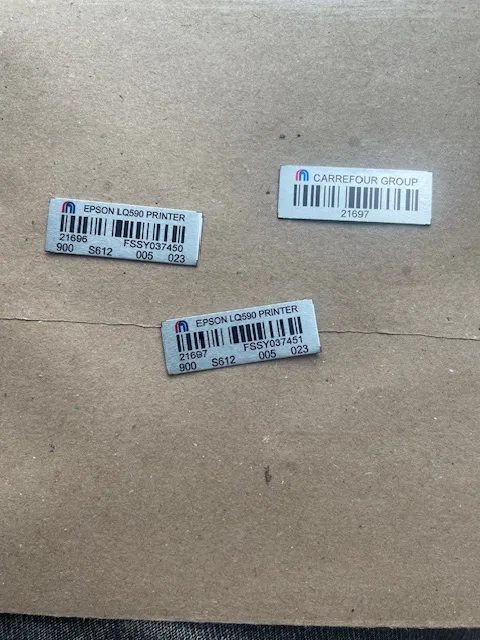
The specification that survives is one where the marking is in the surface rather than on it: anodised aluminium where the shape allows, or acetone-activated tags that bond into the substrate. On smooth casings that cannot take metal, a chemical-resistant laminated polyester is the compromise.
Where to fit the tag on clinical equipment
Three constraints apply at once: it must not interfere with the clinical function, it must not sit where it is repeatedly wiped, and it must be readable without dismantling anything.
In practice that usually means the rear or side of the housing rather than the front panel, above the level where cleaning cloths sweep, and away from any patient or sample contact surface. On trolley-mounted equipment, tag the device and the trolley separately if they can be separated.
Agree positions with the biomedical or laboratory lead before tagging starts rather than during. They will know which surfaces are cleaned hardest and which panels come off for servicing.
Capture the fields that this sector actually needs
| Field | Why it matters here |
|---|---|
| Serial number | Manufacturer recalls, service contracts and warranty claims all work off serial, not your asset number. |
| Make and model | Determines consumables, service intervals and compatibility. Also the fastest way to spot duplicate records. |
| Funding source | Donor-funded equipment carries reporting obligations that outlast the project. Capture it at tagging or reconstruct it painfully later. |
| Department and custodian | Clinical equipment moves between wards constantly. A named custodian is what makes that traceable. |
| Condition and service status | The difference between an asset in use, an asset awaiting repair and an asset that should be written off. |
| Warranty expiry | On equipment at this value, missing a warranty claim is a real financial loss. |
Donor-funded equipment needs its own discipline
In hospitals, health centres and research laboratories across the region, a large share of the equipment was bought by somebody else. Funders typically require that their equipment can be identified individually, traced to the grant that bought it, and accounted for when the project ends.
Those obligations frequently outlive both the project and the staff who ran it, which is exactly why they have to live on the asset rather than in somebody’s memory.
Capture the funding source as a structured field, not a note. The difference is whether donor reporting is a filter you run in two minutes or an archaeology exercise through five years of procurement files.
Plan a healthcare asset tagging project
Tell us the asset types, locations and reporting requirements. We will recommend the register fields, tag materials and verification approach. Request an industry-specific plan →
Reconciling biomedical and finance records
Most health facilities have two lists. Biomedical engineering keeps one, built around service history and technical detail. Finance keeps another, built around cost and depreciation. They rarely agree.
The tagging exercise is the opportunity to reconcile them, and the reconciliation is usually the most valuable output of the whole project. Work from what is physically present, match it to both lists, and report the differences rather than absorbing them.
Do not try to merge two unverified lists into a third list. That produces a record that is wrong in new and harder to detect ways.
Disposal has an extra step
Clinical and laboratory equipment can hold patient data, sample data or hazardous material. Imaging workstations, analysers and multifunction devices all commonly retain storage.
Before an asset leaves, storage should be wiped or physically destroyed and that step recorded against the asset number. Where equipment is contaminated, decontamination must be documented too.
Donor conditions may also restrict what can be done with equipment at end of life, including whether it can be sold at all. Check the grant terms before disposal rather than after.
Common questions about tagging laboratory and medical equipment
Will tags survive autoclaving?
Ordinary tags will not. Instruments that are routinely autoclaved need either an engraved or acetone-activated mark, or identification held at tray level rather than on each instrument.
Can we tag equipment without disrupting clinical work?
Yes. Tagging is done department by department on a schedule agreed with the clinical leads, working around occupancy rather than requiring areas to be cleared.
What about equipment on loan from a supplier?
Record it, marked clearly as not owned, so it appears in the physical inventory but not in the capitalised register. Loan equipment that is invisible to the register is how organisations end up insuring or writing off things they do not own.
How do we handle equipment shared between departments?
Assign a custodian in the department that holds it most of the time, and use transfers to record movement. Shared with no named holder means nobody reports it missing.
Does the register replace the biomedical maintenance system?
No. They serve different purposes. What matters is that both refer to the same asset number so the two records can be cross-referenced.
Is a paper register acceptable for donor reporting?
Increasingly not. Most institutional funders now expect individually identifiable equipment with verifiable records, and several ask for evidence that a physical verification took place.
If you are doing this for the first time, test one tag on one machine through a full week of normal cleaning before ordering the batch. It is the cheapest test available.
Continue with the right next guide
Plan a healthcare asset tagging project
Tell us the asset types, locations and reporting requirements. We will recommend the register fields, tag materials and verification approach.