Asset tagging in Kenya, done properly.
Asset tagging in Kenya has one constant across every county we work in, which is that the register is only as good as the tag that survived the first year. We label every asset you own with a durable barcode or QR tag, verify it on-site, and hand you a complete, audit-ready register, for businesses anywhere in Nairobi or the other 46 counties.
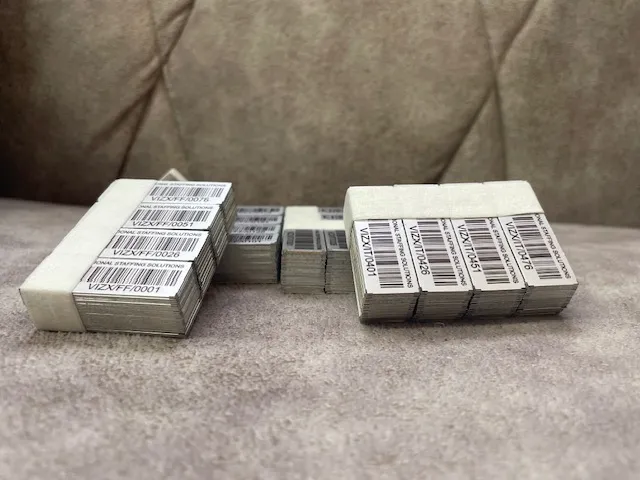
What is fixed asset tagging?
Asset tagging is the process of attaching a unique barcode or QR code label to each of your business’s fixed assets (IT equipment, furniture, machinery, vehicles and more) so every item can be identified, tracked and accounted for at a glance. Each tag links back to a central asset register that records the item’s location, condition, custodian and value.
For Kenyan businesses managing assets across multiple offices, branches or counties, asset tagging turns a stack of spreadsheets and guesswork into an auditable, scannable system: reducing loss, speeding up audits, and giving finance teams accurate depreciation records.
This matters beyond convenience. Under the Income Tax Act, capital allowance and depreciation claims need to be backed by a defensible fixed asset register, and the Kenya Revenue Authority can and does query claims that aren’t supported by verifiable records. A tagged, auditable register is the clearest way to show that an asset genuinely exists, is in use, and is correctly valued.
Asset tagging services in Nairobi & all 47 counties
Barcode asset tags
Durable 1D barcode labels for fast, reliable scanning with standard barcode readers, ideal for high-volume asset registers.
QR code asset tags
QR tags store more data and scan with any smartphone camera: no dedicated scanner required for quick field checks.
Anodized aluminium tags
Rigid aluminium tags built to survive outdoor conditions, heat and heavy handling: the standard for machinery and vehicles.
Self-adhesive tags
Polyester and vinyl tags with a pressure-sensitive backing. The fastest option for high-volume office rollouts, and perfectly durable indoors.
Acetone-activated tags
The adhesive is activated with acetone at application, bonding hard to the surface. The strongest permanent option, for high-value or theft-prone assets.
Polyester tags for soft furnishings
Specified for mattresses, carpets, curtains and upholstered furniture, where a standard office sticker lifts off within weeks.
Which tag suits which asset
| Asset | Recommended tag | Expected life |
|---|---|---|
| Laptops, monitors, printers | Self-adhesive polyester | Life of the asset |
| Desks, chairs, cabinets | Self-adhesive vinyl | Several years |
| Machinery, generators, plant | Anodised aluminium | 5+ years |
| Vehicles and trailers | Anodised aluminium | 5+ years |
| High-value portable equipment | Acetone-activated or tamper-evident | Life of the asset |
| Mattresses, carpets, curtains | Polyester for soft furnishings | Through cleaning cycles |
Most projects use two or three tag types across one register, specified per asset class. Full detail on our asset tags page.
How much does asset tagging cost in Kenya?
We publish real pricing because we think you shouldn’t have to book a call just to find out if we’re in budget. Final pricing depends on tag material, order volume and whether on-site data capture is included.
| Volume | Barcode / QR tag | Includes |
|---|---|---|
| 20 to 100 tags | From KSh 150 / tag | Pre-tagging count & categorisation, design, printing |
| 101 to 1,000 tags | From KSh 100 / tag | + On-site tagging & data capture |
| Above 1,000 tags | From KSh 80 / tag | + Asset register, soft & hard copy |
Illustrative tiers: confirm current pricing with our sales team. Pair with our Asset Management Software for KSh 120,000 one-time, no monthly fee.
Why Kenyan businesses need fixed asset tagging
Untagged assets are assets you can’t prove you own. Three reasons this keeps coming up with the organisations we work with:
Audits and compliance
Statutory and internal auditors increasingly expect a verifiable register, not a spreadsheet someone updates when they remember to. A tagged asset with a documented history is far easier to defend during an audit.
Insurance and loss prevention
A tagged, photographed, serial-numbered asset is a claim you can actually win. An untagged one is a dispute, and disputes take months to resolve.
Operational efficiency
Manual stock-takes on an untagged estate can take days and still miss things. Scanning a tag takes seconds and can’t misread a description the way a person can.
This isn’t a uniquely Kenyan concern; it’s formalised internationally in standards like ISO 55000 for asset management. It matters more here precisely because relatively few local businesses have adopted it yet, which means the ones that have are noticeably harder to catch out during an audit.
Two ways to do asset tagging in Kenya
Most organisations start with one of these and add the other within a few months. Here’s exactly what’s included in each.
Asset Tagging
Every asset in your business gets a durable barcode or QR tag, verified on-site before it’s recorded, and rolled into a single register you can hand straight to your auditor. Aluminium tags for machinery and vehicles, polyester for everyday office equipment.
- Pre-tagging count and categorisation
- On-site tagging with full data capture
- Finished register, delivered as soft and hard copy
Asset Management Software
Once your assets are tagged, our software keeps the register current: depreciation runs automatically, custodians and locations stay up to date, and reports are ready the moment an auditor asks for them.
- Automatic straight-line depreciation
- Works on any device, with unlimited staff accounts
- Full setup and staff training included
From first call to finished register
The underlying workflow is the same for every project, regardless of size. Here’s what actually happens at each stage.
Scoping
You tell us roughly how many assets you have and where they’re located. We give you a same-day estimate based on volume and material.
Verification
Every asset is checked against your existing records, or counted fresh if there isn’t one, before a single tag is printed. This step catches assets written off years ago but never removed, and the reverse.
Tagging and data capture
The physical tag goes on, and its make, model, serial number, condition, location and custodian are recorded against the tag’s unique code as we go.
Register delivered
You receive a complete, exportable asset register, ready to hand to finance or load straight into asset management software if you’ve ordered it.
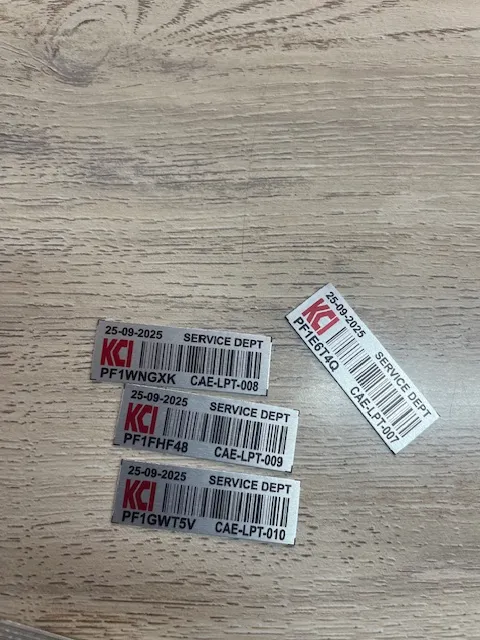
Services our asset tagging company offers
Pre-tagging verification: physical confirmation of every asset before it’s added to the register.
Fixed asset tagging & data capture: on-site tagging with full data capture per asset.
Asset register development: a clean, audit-ready register built from your tagged data.
Ongoing asset audits: pair tagging with our asset management system for continuous tracking, not just a one-time count.
Which assets require tagging?
As a rule of thumb, if an item is worth tracking on a balance sheet, has a useful life longer than a year, and could plausibly go missing or be misallocated, it belongs on the list. That includes soft furnishings such as mattresses, carpets and curtains, which are among the most commonly untagged assets on a hospitality balance sheet. In practice the list usually covers:
IT Equipment
Furniture
Vehicles
Medical Equipment
Machinery & Tools
Electronics
What to look for in an asset tagging company
- Transparent pricing. If a company won’t publish even a rough price range, that’s worth asking about directly. We publish ours above.
- Pre-tagging verification included, not sold as a separate add-on you have to know to ask for.
- A real, exportable asset register at the end, not just stickers applied to your equipment.
- A path to ongoing management, ideally software that keeps the register current after the initial project rather than a one-off count that goes stale within a year.
If you want the fuller background before you commit to a provider, our guide on what asset tagging actually is covers the definitions, the common mistakes, and how to tell fixed asset tagging apart from digital asset management software.
Organisations we’ve tagged across Kenya
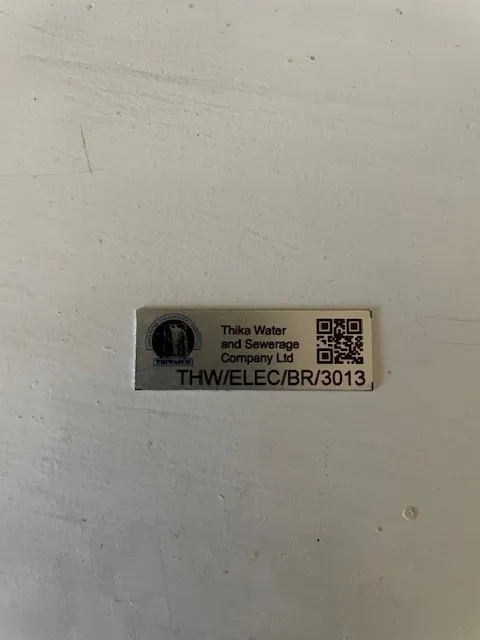
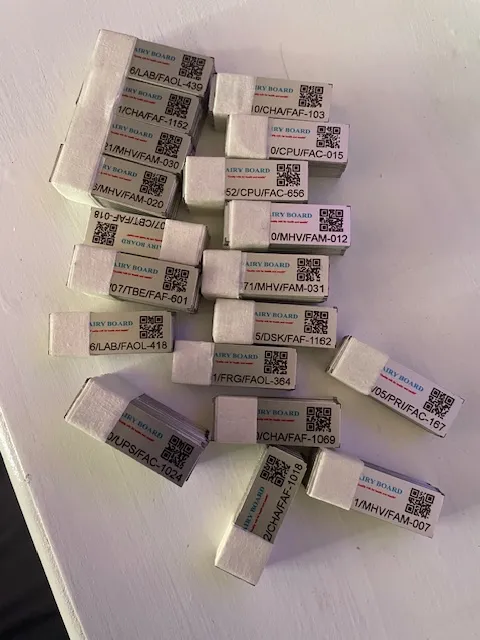
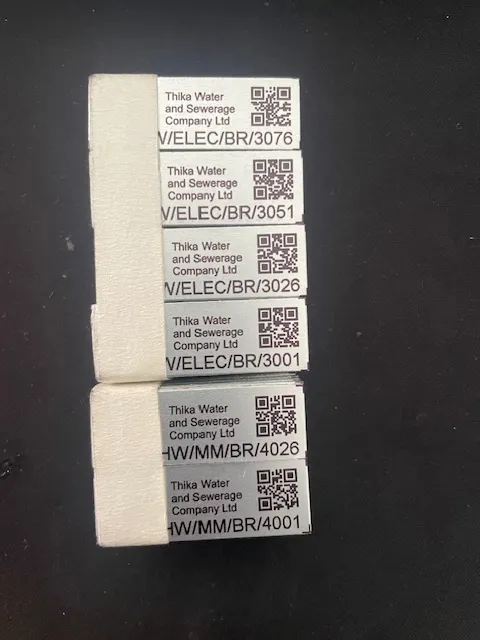
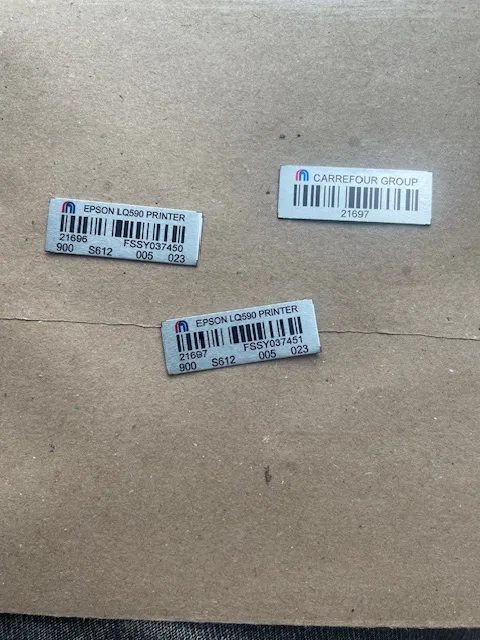
The photo alongside shows self-adhesive tags of the kind we produce for IT equipment. It’s a fair sample of the range of work we handle, from a handful of tags for a single branch to full-estate projects spanning multiple counties.
We’ve tagged over 5,000 assets across 20+ branches for Kenya Dairy Board, more than 2,000 across seven branches for Thika Water and Sewerage Company, over 3,000 plus a 10,000-item inventory count for Pax Manor, and around 600 for the NGO Hennet, alongside Maisha Bora Sacco, Mombasa County schools and smaller offices with a few dozen laptops and desks. The process is the same regardless of scale: verify, tag, record, deliver.
Built for organisations with assets to protect
Why you should choose our asset tagging company
Quality asset tags
Rigid aluminium tags, 0.5mm thick, built for harsh indoor and outdoor conditions. Polyester and vinyl options cost less where the environment is less demanding.
Qualified personnel
A trained tagging team focused on solutions that fit your long-term goals, not a generic script applied to every client.
Reliable support
We follow up after delivery to keep improving how we serve you, and stay reachable if a question comes up months later.
On-time delivery
We deliver per the agreed timeline, wherever you are in Kenya, including multi-branch and multi-county projects.
Best prices
Transparent, fair pricing regardless of the size of your business, published up front rather than quoted only after a sales call.
Professionalism
An intensively trained team focused on meeting your expectations, from the first site visit through to the delivered register.
Common questions about asset tagging in Kenya
Do I need both services?+
What areas do you cover?+
How is tagging priced?+
Is the software a subscription?+
How long does a typical project take?+
Do you provide ongoing support?+
What is the difference between a barcode and a QR code tag?+
What is asset tagging and verification?+
Can you tag mattresses, carpets and soft furnishings?+
What tag types do you offer?+
Do you have examples of businesses you’ve worked with?+
Can I switch tagging providers if I already have a register?+
Budget asset tagging in Kenya by asset count and site count, not by floor area. Two hundred assets spread over six branches is a longer project than eight hundred in one building, and the travel is what moves the number.
Ready to get your assets under control?
Call us to discuss your organisation, or email your asset list and we’ll scope it for you.