
Organisations we have tagged.
These asset tagging case studies cover four very different estates, and the pattern that repeats across all of them is worth more than any single number in them. Real projects for real clients, from a 600-asset NGO to a 5,000-asset national rollout across more than twenty branches. Every photo on this site is a tag we actually produced.
Projects by scale and sector
| Client | Sector | Scope | Year |
|---|---|---|---|
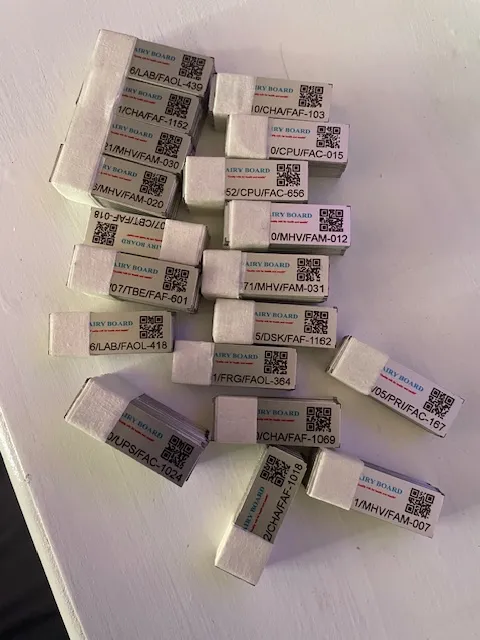
| Kenya Dairy Board | Government and parastatal | 5,000+ assets, 20+ branches nationwide | 2024 |
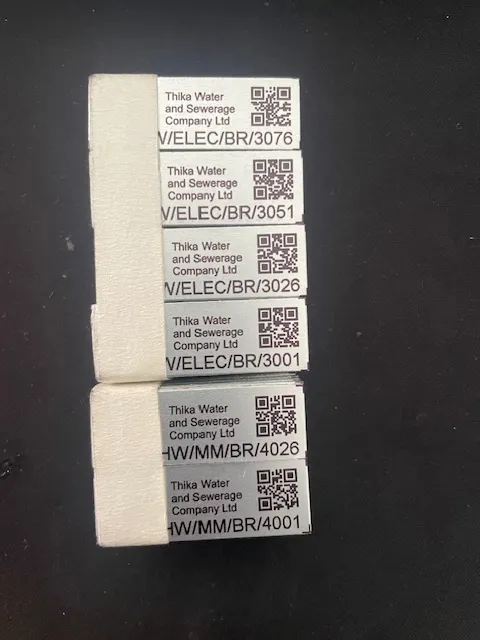
| Thika Water and Sewerage | Utilities | 2,000+ assets, 7 branches | 2025 |
| Pax Manor | Hospitality | 3,000+ assets, plus 10,000+ inventory items | Delivered |
| Hennet | NGO and non-profit | 600 assets | Delivered |
Asset tagging case studies: client projects
Kenya Dairy Board
Over 5,000 assets tagged across more than 20 branches nationwide in 2024, including verification and cleanup of an existing register that had drifted out of line with reality.
Thika Water and Sewerage Company
More than 2,000 assets across seven branches in 2025, with tags specified per environment for electrical and operational plant as well as office equipment.
Pax Manor
A new hotel opening: over 3,000 fixed assets tagged by department, plus inventory management for more than 10,000 items, including polyester tags on mattresses and soft furnishings.

Hennet
Around 600 assets tagged and verified for a non-governmental organisation, with capture structured for the donor reporting an NGO actually has to produce.
Organisations across Kenya
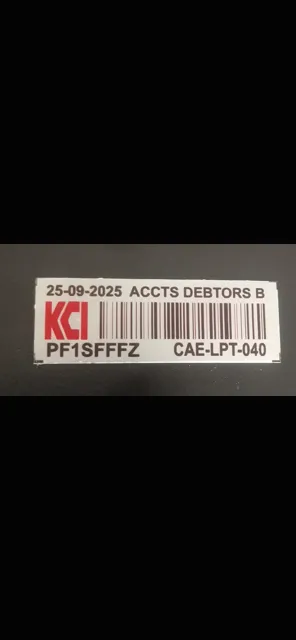
Carrefour Kenya, Maisha Bora Sacco, ISM, Riara Group, Vizx Global Solutions, KCI, Mombasa County schools and Executive Residency, alongside many smaller offices with a few dozen assets each. The process is the same regardless of scale.
Read these asset tagging case studies for the starting position rather than the finished register. Every one of them began with a list that nobody trusted, and the work that followed was mostly physical rather than technical.
What the four projects have in common
The estates below have almost nothing in common on paper. One is a water utility with plant sitting outdoors across seven branches, one is a hotel where most of the value is furniture and fittings in guest rooms, one is a national board spread over twenty-plus locations, and one is an NGO whose equipment moves between field sites. The tags differ, the numbering differs and the timelines differ.
What repeats is the starting position. In every case the organisation already had a list, and in every case nobody was willing to sign it. The list had been maintained by different people in different formats over several years, the same item was described three different ways depending on which branch entered it, and there was no way to tell from the record whether a given asset still existed. That is the normal condition of a fixed asset register that has never been physically verified, and it is not a sign that anybody did anything wrong.
What also repeats is the sequence. Agree the category list and the numbering convention centrally before anything is printed. Specify the tag around the surface and the environment it has to survive, which usually means more than one tag type across a single estate. Apply, then verify physically, then reconcile to the ledger. Doing verification before application, or skipping it entirely, is the single most common way these projects end up being paid for twice.
The last thing they share is what the organisation holds at the end. Not a report, but a live register with a custodian against every line, an audit trail behind every movement, and a depreciation schedule that comes out of the same data rather than being maintained separately in a spreadsheet. The asset counts below are the headline figures. The register is the deliverable.
Ready to get your assets under control?
Call us to discuss your organisation, or email your asset list and we’ll scope it for you.