
Hennet
NGO asset tagging carries a reporting burden that commercial estates do not, because the register has to satisfy donors as well as auditors. Fixed asset tagging and register development for a non-governmental organisation, covering approximately 600 assets.
NGO asset tagging at a glance
| Client | Hennet |
|---|---|
| Sector | NGO and non-profit |
| Year delivered | Delivered |
| Scope | 600 assets tagged |
| Tag types used | Self-adhesive tags across office equipment, furniture and programme assets |
Where they started
NGOs carry an accountability burden that commercial organisations do not. Assets are frequently purchased with donor or grant funding, and that funding usually comes with an obligation to demonstrate what was bought, that it still exists, and that it is being used for its intended purpose.
That makes asset records a reporting requirement rather than an internal convenience. A commercial business with a vague register faces an awkward audit. An NGO with a vague register faces questions from the people funding it.
At around 600 assets, Hennet sat at a scale where a spreadsheet is technically workable but already fragile: large enough that nobody holds it in their head, small enough that a heavyweight system would be disproportionate.
Our approach
Physical verification first. Every asset was confirmed on site before anything was printed, so the register reflects what the organisation actually holds rather than what it believes it holds.
Capture built for donor reporting. Alongside the standard fields, capture was structured so assets can be filtered and reported in the groupings an NGO actually needs when accounting for how funds were spent.
Right-sized tagging. At 600 assets there was no case for over-engineering. Tags were specified for the environments involved, applied, and recorded, without adding complexity the organisation would then have to maintain.
A register they can actually keep current. The deliverable was a clean, exportable register that a small team can maintain, rather than one that decays the moment the project ends.
Tags produced for Hennet
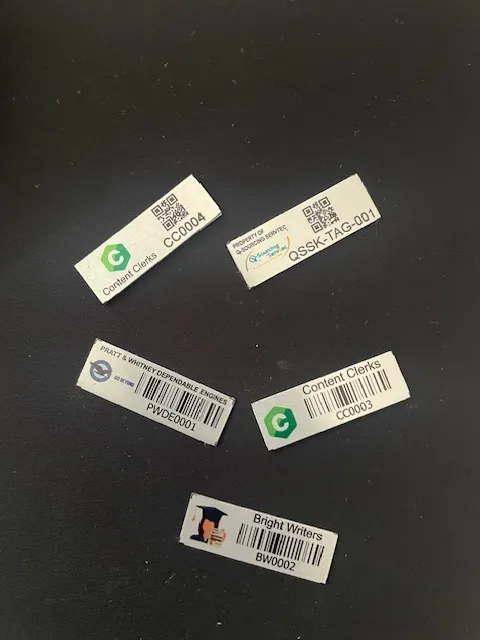
Tags specified for office equipment and programme assets.

Printed and batched before the site visit.
What they have now
Hennet holds a verified register covering approximately 600 assets, each carrying a scannable tag linking it back to its record.
For an organisation answerable to funders, the value is being able to answer the question directly. Asked whether a specific item still exists and where it is, the answer comes from a record that was physically verified, not from a search through purchase orders.
Running a non-profit or donor-funded programme? See our asset tagging services and transparent pricing.
Two things make NGO asset tagging different in practice. The first is that assets are often bought under a specific grant, so the register has to carry the funding source alongside the cost. The second is that programme equipment moves between field sites far more often than office equipment moves between desks, which means custody has to be recorded at the individual level and updated as part of the handover rather than months later. Both are straightforward to handle, but only if they are designed into the register before tagging starts rather than retrofitted afterwards.
The verification pass is what turned the list into a register. Every item was located, condition-checked and matched to a custodian before it was written back, so the closing figures were built from what was physically present rather than from what the previous records claimed. Items that could not be found were flagged as exceptions rather than quietly dropped, which is the part auditors ask about first.
Ready to get your assets under control?
Call us to discuss your organisation, or email your asset list and we’ll scope it for you.