
Kenya Dairy Board
Government asset tagging is a coordination exercise before it is a tagging exercise, because the assets sit in branches that have never shared a numbering convention. A nationwide fixed asset tagging and register verification programme covering more than 5,000 assets across over 20 branches.
Government asset tagging at a glance
| Client | Kenya Dairy Board |
|---|---|
| Sector | Government and parastatal |
| Year delivered | 2024 |
| Scope | 5,000+ assets tagged |
| Tag types used | Barcode and QR tags across IT equipment, furniture and office assets |
Where they started
Kenya Dairy Board already had a fixed asset register. That is a better starting point than most organisations have, but it also creates a specific problem: an inherited register carries years of accumulated drift. Assets get disposed of without being written off. Equipment moves between branches without the record following it. Items appear twice under slightly different descriptions.
With more than 20 branches spread across the country, that drift is invisible from head office. Nobody can walk the estate to check. The register says one thing, the branches hold another, and the gap only surfaces when an auditor starts asking.
The requirement was not simply to apply tags. It was to establish what the organisation actually owned, reconcile that against the existing register, and leave behind a record that could be trusted.
Our approach
Verification before printing. We worked from the existing register rather than around it. Every branch was visited and every asset physically confirmed against the record. Items on the register that no longer existed were flagged. Items in the branches that were missing from the register were captured and added.
Cleanup and reconciliation. Duplicate entries were merged, inconsistent descriptions standardised, and disposals that had never been recorded were documented. This is the step that turns an inherited register into a defensible one, and it is the step most often skipped.
Tagging to a consistent convention. Only once the data was reconciled did we print. Every asset received a tag under a single numbering convention that encoded branch and asset class, so a code is readable by a person and sortable by a spreadsheet.
Nationwide coordination. Twenty-plus branches means travel, scheduling around each site’s operations, and keeping data consistent across teams working in different locations.
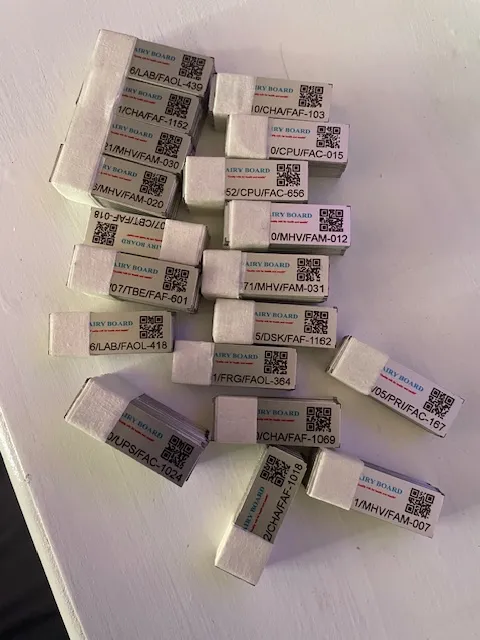
Tags produced for Kenya Dairy Board
Tags grouped by asset class across an institutional estate.

Production ahead of a multi-branch rollout.
What they have now
Kenya Dairy Board came out of the project with a single reconciled fixed asset register covering the whole estate, where every line item corresponds to a physical asset that was seen and verified, and every physical asset carries a scannable tag tying it back to that record.
The practical difference is in what happens at audit. Rather than reconstructing the position from memory and paperwork, the register is the position, and any line in it can be checked by scanning the asset it refers to.
If you have an existing register you no longer fully trust, this is the pattern that fixes it. See our asset tagging services or read about how verification works.
The hardest part of government asset tagging at this scale is not the volume, it is agreeing one category list that every branch will use. Branches that have kept their own records for years each have a defensible way of describing the same chair, and until that is settled centrally the consolidated register cannot be summarised by category at all. We settle it before the first tag is printed, then apply it uniformly, which is why a twenty-branch estate can still produce a single clean depreciation schedule at the end.
Ready to get your assets under control?
Call us to discuss your organisation, or email your asset list and we’ll scope it for you.