Thika Water and Sewerage Company
Utility asset tagging puts a large share of the estate outdoors, which rules out most of the tag materials that work perfectly well in an office. Fixed asset tagging and register development across seven branches for a water and sewerage utility, covering more than 2,000 assets.
Utility asset tagging at a glance
| Client | Thika Water and Sewerage Company |
|---|---|
| Sector | Utilities |
| Year delivered | 2025 |
| Scope | 2,000+ assets tagged |
| Tag types used | QR tags on electrical and operational plant, self-adhesive tags on office assets |
Where they started
Utilities carry a harder asset mix than most organisations. Alongside the usual office equipment and furniture, there is electrical and operational plant: equipment that lives in pump houses and plant rooms, is exposed to moisture and washdown, and is handled by technical staff rather than office staff.
Spread that across seven branches and two problems compound. First, a tag specified for an office desk will not survive on a piece of electrical plant. Second, assets in operational environments move as maintenance requires, so a register that is accurate on the day it is written starts degrading immediately unless the identification is physically attached to the asset.
Our approach
Tag specification by environment, not by convenience. We did not apply one tag type across the estate. Assets in plant rooms and exposed positions received durable tags rated for those conditions, while office and administrative assets received standard self-adhesive tags. Specifying per environment costs slightly more up front and avoids re-tagging within a year.
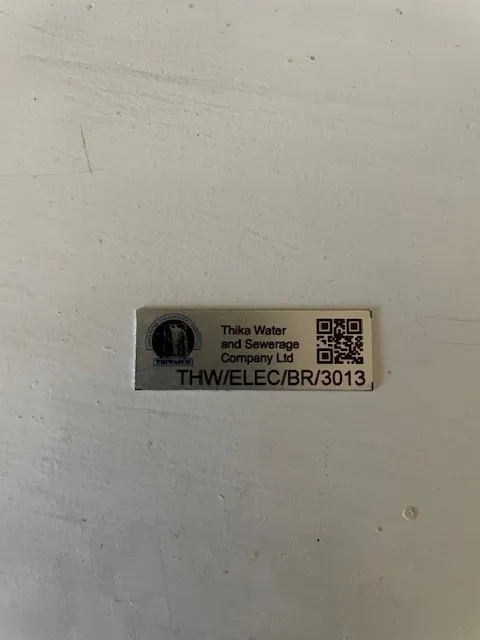
A numbering convention that encodes function. Codes such as THW/ELEC/BR/3013 carry the organisation, the asset class and the branch within the identifier itself, so an asset can be placed without opening the register.
Branch-by-branch physical verification. Each of the seven branches was worked through in turn, with assets confirmed, captured and tagged on site rather than compiled remotely.
Register delivery. The captured data was consolidated into a single register covering all seven branches, with each asset traceable to its location and custodian.
Tags produced for Thika Water and Sewerage Company
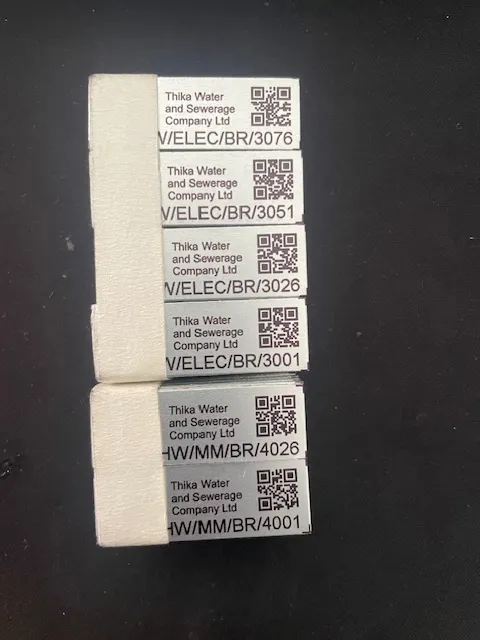
QR tags batched by branch before deployment.
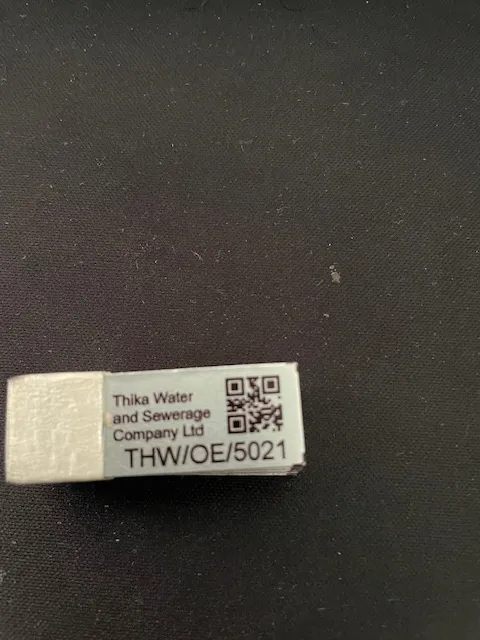
Finished tag, coded by asset class and branch.
What they have now
Thika Water and Sewerage Company holds a consolidated register covering more than 2,000 assets across all seven branches, with tags specified to survive the environments they were actually placed in.
For a utility, the operational value is as significant as the audit value: knowing which pump, panel or piece of plant sits at which branch, and being able to confirm it by scanning rather than by asking whoever has been there longest.
Operating across several sites with mixed indoor and industrial assets? See how we specify tags per environment or our tagging services.
The specification question in utility asset tagging is always the same. Pumps, valves, panels and metering equipment sit in sun, rain and occasionally standing water, so the tag has to be anodised rather than printed and fixed rather than adhesive. Indoor administrative assets in the same organisation do not need any of that, and paying for it across the whole estate is waste. We split the estate by exposure first, then specify two tag types, which is almost always cheaper than one compromise tag that suits neither.
Ready to get your assets under control?
Call us to discuss your organisation, or email your asset list and we’ll scope it for you.