
Asset tags built to outlast the asset.
Asset tags are the cheapest part of a fixed asset project and the part that decides whether the register still works in five years. Barcode, QR code, anodised aluminium, self-adhesive and acetone-activated asset tags, printed to your numbering convention and specified for the surface they will actually live on. Supplied across Kenya and the wider region.
What is an asset tag?
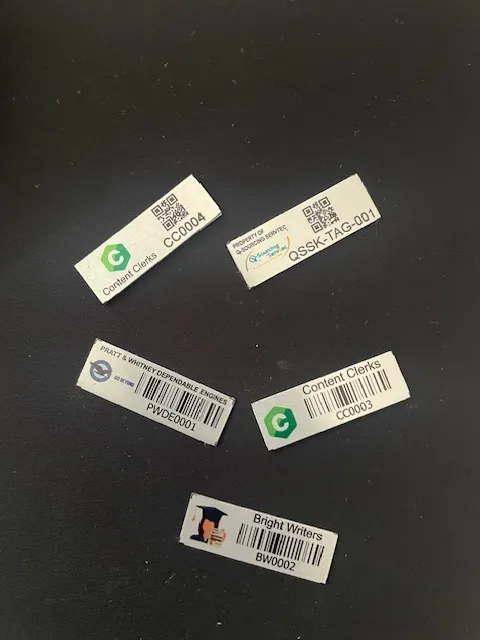
An asset tag is a durable label carrying a unique, machine-readable code that permanently identifies one specific item your organisation owns. Scan the code and you pull up that item’s record: what it is, its serial number, where it should be, who holds it, when it was bought and what it is currently worth.
The distinction that matters is between an asset tag and an ordinary printed label. A retail barcode sticker is designed to survive until checkout. An asset tag is designed to stay legible and attached for the entire depreciable life of the item, through cleaning, handling, heat, sunlight and in some cases rain, vibration or industrial laundry. That difference comes down to three choices: the code format, the tag material, and the way it bonds to the surface.
If you are still deciding whether your organisation needs tagging at all, the wider process is covered in our guide on what asset tagging actually is. This page is about the tags themselves.
Code format: barcode or QR code
This is the question we get asked most often, and the honest answer is that it depends far less on the technology than on who will be doing the scanning.
| Barcode (1D) | QR code (2D) | |
|---|---|---|
| Scanned with | Dedicated barcode reader | Any smartphone camera, or a reader |
| Data capacity | Around 20 characters | Several thousand characters |
| Damage tolerance | One scratch across the bars can stop a read | Built-in error correction, still reads when partly damaged |
| Space needed | Wider, needs a horizontal run | Compact square, fits small items |
| Unit cost | Marginally lower | Marginally higher |
| Best for | Large estates with a dedicated audit team and existing scanners | Organisations where ordinary staff verify assets on their own phones |
If you already own barcode scanners and a trained team uses them, barcodes are perfectly adequate and slightly cheaper. If you are starting from nothing, choose QR. The saving on barcode tags is small, and it disappears the moment you have to buy scanners for each branch.
Tag types we supply
Either code format can be produced on any of the tag types below. What changes is the material and how it bonds to the asset.
Anodised aluminium tags
Rigid metal tags, 0.5mm thick, with the code etched into an anodised surface rather than printed on top of it. Built for machinery, vehicles, generators and anything living outdoors or in a workshop.
- Survives heat, sunlight and washdown
- Code cannot rub or scratch off
- Typically 5+ years outdoors
Self-adhesive tags
Polyester or vinyl tags with a pressure-sensitive backing. Peel and stick. The workhorse of office tagging: fastest to apply, lowest cost, and perfectly durable on clean indoor surfaces.
- Fastest option for high-volume rollouts
- Ideal for laptops, monitors, furniture
- Available in tamper-evident versions
Acetone-activated tags
The adhesive is activated with acetone at the moment of application, so the tag bonds hard to the surface rather than simply resting on it. Once cured it is extremely difficult to remove intact.
- Strongest permanent bond we offer
- Resists peeling, solvents and handling
- Best for high-value or theft-prone assets
Polyester tags for soft furnishings
Purpose-specified polyester tags for mattresses, carpets, curtains, upholstered furniture and other soft or textile assets, where a standard office sticker will not hold. See the section below.
- Bonds to fabric and textile surfaces
- Survives cleaning and rotation
- Built for hospitality estates
Which asset tags do I need?
Most asset tags that fail do not fail because the code was wrong. They fail because the material or adhesive was never rated for the surface it ended up on. Find your asset type below.
| Asset | Recommended tag | Why | Expected life |
|---|---|---|---|
| Laptops, monitors, printers | Self-adhesive polyester | Clean, flat, indoor surface. Nothing stronger is needed | Life of the asset |
| Desks, chairs, cabinets | Self-adhesive vinyl | Low-risk indoor furniture, cost-sensitive at volume | Several years |
| Machinery, generators, plant | Anodised aluminium | Heat, vibration, oil and washdown destroy printed labels | 5+ years |
| Vehicles and trailers | Anodised aluminium | Outdoor exposure and sunlight | 5+ years |
| High-value portable equipment | Acetone-activated or tamper-evident | Removal resistance matters more than cost | Life of the asset |
| Mattresses, carpets, curtains | Polyester for soft furnishings | Textile surfaces will not hold a standard adhesive | Through cleaning cycles |
| Lab and medical equipment | Self-adhesive polyester | Wipe-down and cleaning agents, indoor | Life of the asset |
If your estate spans several of these, that is normal. Most projects we run use two or three tag types across a single register, specified per asset class rather than applying one tag to everything.
Tagging soft furnishings: mattresses, carpets and curtains
Soft furnishings are the assets organisations most often leave untagged, and they are frequently among the most valuable line items on a hospitality balance sheet. A hotel can carry hundreds of mattresses and thousands of square metres of carpet, all of it depreciating, all of it moving between rooms, and none of it traceable.
The reason they get skipped is practical: a standard office sticker will not stay on fabric. It lifts at the edges, collects dust underneath, and comes away entirely the first time the item is cleaned or rotated. So the item goes on the register as a bulk line, or does not go on at all.
We specify polyester tags for these surfaces, applied so they survive routine cleaning and the repeated handling that comes with room turnover. That makes it possible to track a mattress by room, record its purchase date, and know when the replacement cycle is genuinely due rather than guessing.
Hotels, serviced apartments, hostels, student accommodation, healthcare facilities with patient bedding, and any organisation running a linen or furnishing replacement cycle. If you are budgeting mattress replacement from memory rather than from a register, this is the gap.
We handled exactly this on a hospitality project covering housekeeping and departmental assets alongside a separate inventory count. See the Pax Manor case study for how a soft furnishings register works in practice.
Numbering conventions
Every tag we print carries a unique code, and that code should mean something to your finance and procurement teams rather than being an arbitrary serial. A convention worth using generally encodes location, asset class and a sequence number.
Looking at tags we have produced for real clients, you can see the pattern: THW/ELEC/BR/3013 for a Thika Water electrical asset, or CAE-LPT-018 for a laptop in a corporate estate. Both are readable by a human at a glance and sortable by a spreadsheet.
Get this decided before anything is printed. Changing a numbering convention after the tags are on the assets means either re-tagging or maintaining a translation table forever, and neither is pleasant. If you do not have a convention yet, we will propose one based on your organisation structure and your existing asset register.
Asset tags we have printed
Every photo below is a tag we actually produced and delivered, not a stock image or a render.
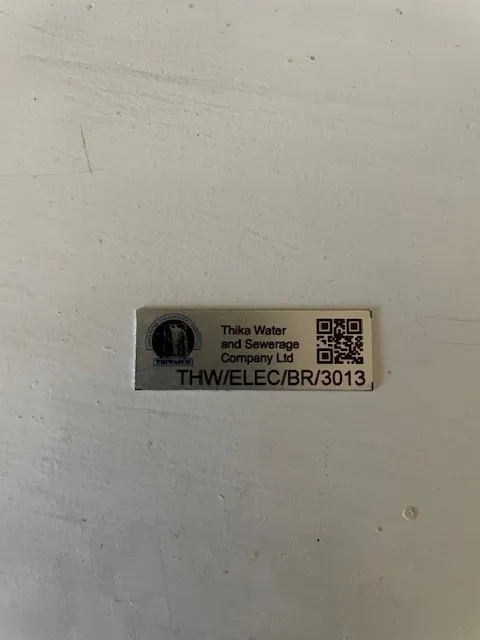
QR tag, utility sector. Thika Water.
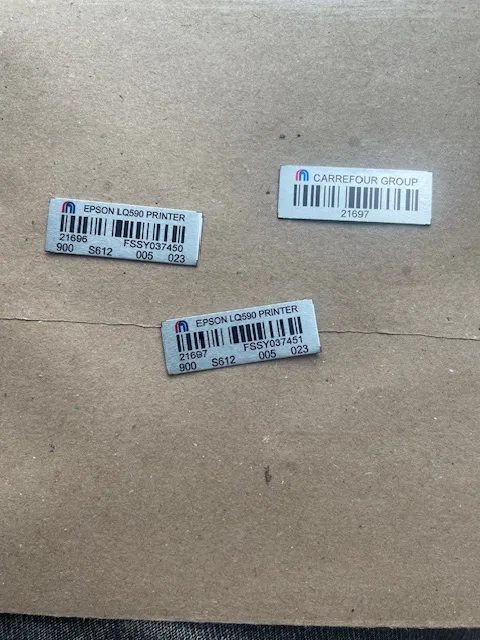
Self-adhesive tags for IT equipment.

Hospitality furniture and fittings. Pax Manor.
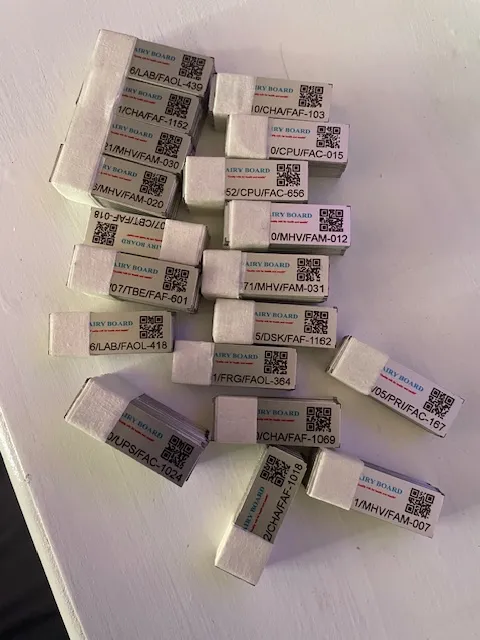
A full office inventory, tagged by asset class.
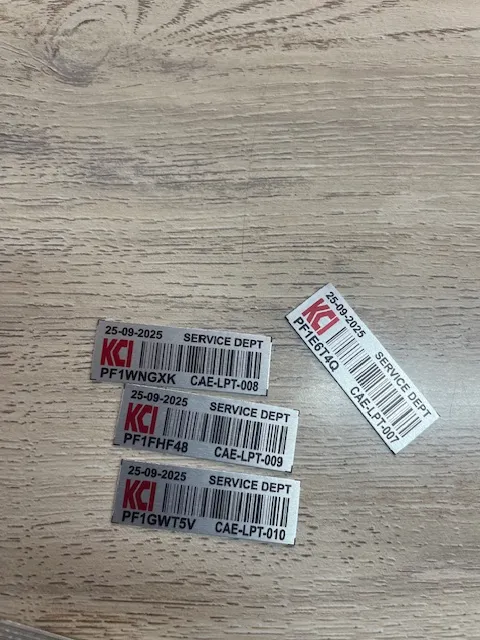
Branded metal tags with client logo.
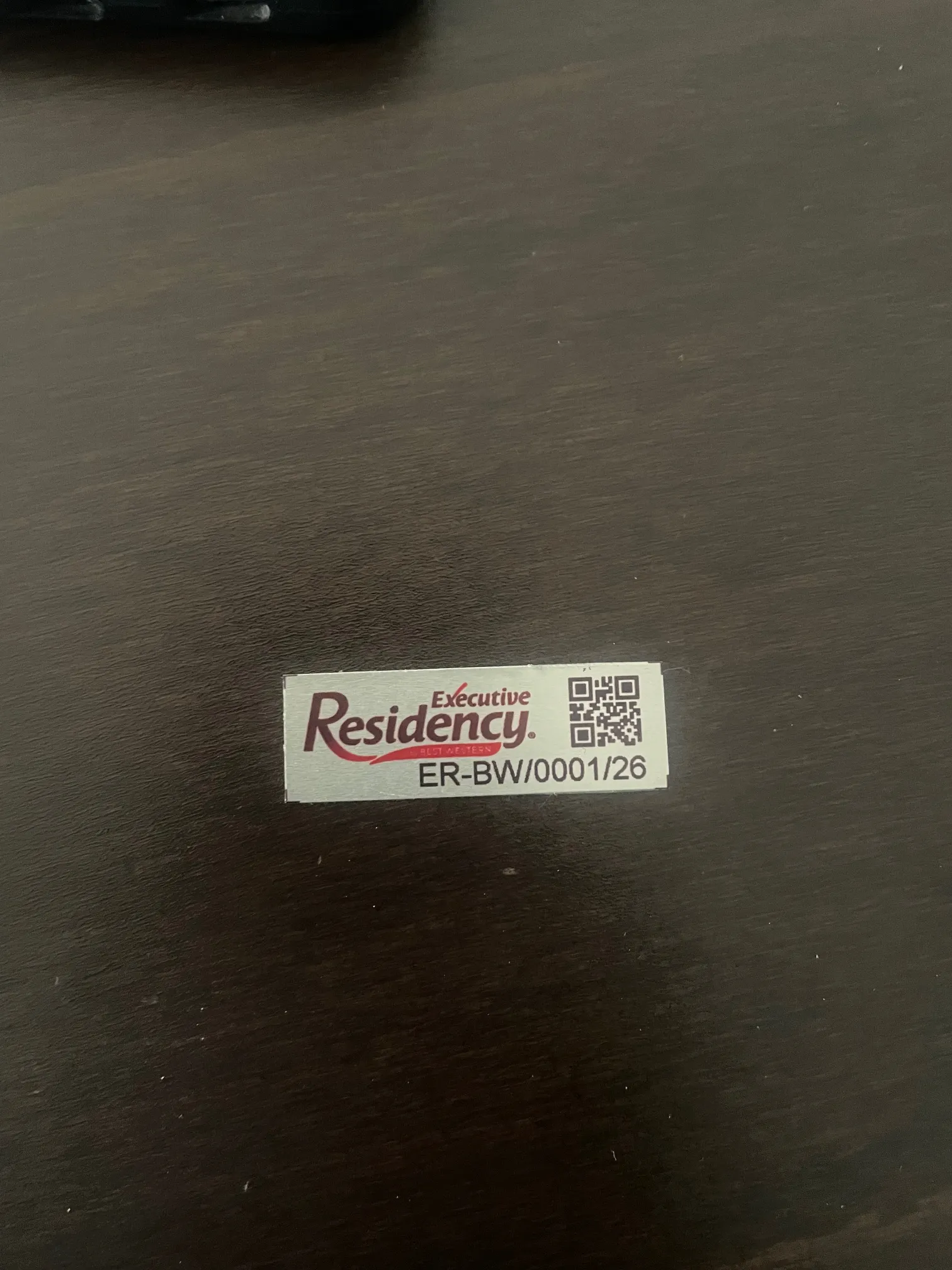
Branded QR tag. Executive Residency.
How much do asset tags cost?
We publish pricing because you should not have to book a call to find out whether we are in budget. Final cost depends on tag type, order volume and whether you want us on site doing the data capture as well as supplying the tags.
| Volume | Barcode / QR tag | Includes |
|---|---|---|
| 20 to 100 tags | From KSh 150 / tag | Design, numbering and printing |
| 101 to 1,000 tags | From KSh 100 / tag | Plus on-site tagging and data capture |
| Above 1,000 tags | From KSh 80 / tag | Plus full asset register, soft and hard copy |
Illustrative tiers, confirm current pricing with our sales team. Anodised aluminium and acetone-activated tags carry a premium over self-adhesive polyester and vinyl. Full service pricing is on our pricing page. Pricing for markets outside Kenya uses the same published KSh tiers, with travel and mobilisation quoted separately on our Africa page.
Common questions about asset tags
What are acetone-activated asset tags?+
Can you tag mattresses, carpets and other soft furnishings?+
What is the difference between self-adhesive and acetone-activated tags?+
Can you print our logo on the tags?+
What is the minimum order?+
How long do asset tags last?+
Can asset tags be removed or moved to another item?+
Do we need software to use the tags?+
Do you supply outside Kenya?+
One practical note before you order asset tags: decide the numbering convention first, then the material, then the size. Doing it in that order means the tag is specified around the register rather than the register being bent around whatever tag arrived.
Ready to get your assets under control?
Call us to discuss your organisation, or email your asset list and we’ll scope it for you.