
What to ask before you appoint an asset tagging supplier
Choosing an asset tagging supplier on price alone is how organisations end up paying twice, because the cheap quote almost always excludes the part that makes the register usable. Most tagging quotes are compared on one number: price per tag. That number tells you almost nothing about what you will end up with. These are the questions that separate a supplier who will hand you a working register from one who will hand you a pile of stickers.
In this article
Choosing an asset tagging supplier: the short version
- Price per tag is the least informative number in the quote.
- A single tag specification for a mixed estate means no survey was done.
- The exception report is the deliverable that proves verification actually happened.
- Mobilisation should be quoted separately so you can see what site consolidation saves.
- Confirm in writing that you can export all your data and leave.
On the tags themselves
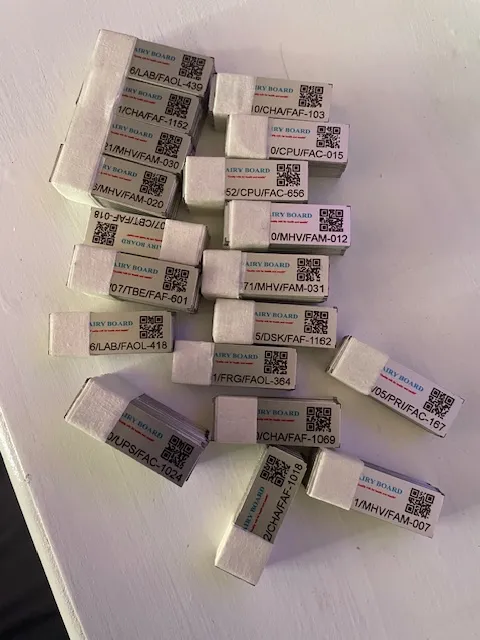
What material are you proposing, and for which positions? A supplier who quotes one specification for the whole estate has not surveyed it. The correct answer describes different materials for offices, plant rooms, wet areas and outdoor positions.
What is the expected life in our worst environment? Not the best case. Ask specifically about your kitchen, your workshop, your coastal site.
Will the asset number be printed in human-readable text as well as encoded? It should be. Scanners fail, tags get dirty, and people need to read numbers over the phone.
Can you print to our numbering scheme? If the answer is that you must use theirs, ask why. Your numbering should follow your organisation, not their production system.
On the data
What fields will you capture? Get the list. Asset number, description, category, serial, location, department, custodian, condition, cost, acquisition date and funding source is a reasonable baseline. A supplier proposing four fields is proposing an inventory, not a register.
How will you handle assets you cannot value? The right answer involves a documented estimate agreed with your finance team, not a zero and not a blank.
What happens to our existing records? They should be reconciled against what is physically found, with the differences reported. A supplier who plans to simply overwrite them is destroying the most useful output of the exercise.
What format do we receive the data in? Something you can move. If the only way to get your data out is through their software, that is a lock-in you are agreeing to.
On the exception report
This is the question that most reliably separates suppliers, because a supplier who has done this work before knows the exception report is the deliverable that matters.
Will we receive a list of assets found that were not on any record? There will be some. There always are.
Will we receive a list of records with no asset behind them? Also always some.
How will discrepancies be reported rather than absorbed? A register that quietly matches your old list is a register that has not been verified.
On people and access
| Ask | What you are testing |
|---|---|
| Who will actually be on site? | Whether the team that quoted is the team that comes, and whether capture is subcontracted. |
| How many people, for how many days? | Whether the timeline is arithmetic or optimism. |
| What access do you need from us, and when? | Whether they have thought about the constraint that actually governs the schedule. |
| How do you handle restricted or clinical areas? | Whether they have worked in an environment like yours. |
| What happens if a site takes longer than quoted? | Whether overrun is your risk or theirs. |
Request a sample tag, sample register and formal quotation
Send the approximate number of assets, branches and preferred tag material. We will return a clear scope and quotation. Request procurement samples →
On the quote structure
Is mobilisation stated separately from the per-asset rate? It should be. A blended rate hides which part of the cost you can influence by consolidating sites or scheduling differently.
What is included and what is extra? Common extras are second visits, out-of-hours work, additional sites, re-tagging of failed tags, and data cleaning of legacy records.
What is the unit? Per tag, per asset or per day. Per asset is usually the clearest, because it aligns the supplier’s incentive with the work rather than with the sticker count.
On what happens afterwards
Will you train our team, and who exactly? Training the person who leaves in three months is not training.
What support is included after handover, and for how long? Get the period and the scope in writing.
If we take your software, can we export everything and leave? The answer should be an unqualified yes.
Can you reprint individual tags later? Tags fail. Being able to reprint a specific number, rather than renumber the asset, matters more than it sounds.
The two answers that should worry you
The first is a single tag specification for a mixed estate. It means either no survey was done or the survey was ignored, and it guarantees a re-tagging exercise.
The second is any reluctance to commit to an exception report. A supplier who does not want to tell you what does not reconcile is a supplier planning to make the numbers agree, which is the opposite of what you are buying.
Common questions about asset tagging supplier
Should we run a formal tender?
For large multi-site estates, yes. For a single site, a written scope and two or three comparable quotes is usually proportionate. What matters is that all bidders are pricing the same scope.
How do we compare quotes that are structured differently?
Ask every bidder to separate mobilisation from the per-asset rate, and to state the same field list. Without that you are comparing different services.
Is the cheapest quote ever the right one?
Sometimes, if the scope genuinely matches. It usually is not, because the difference is normally in tag specification and in whether reconciliation is included.
Should the supplier also provide the software?
Not necessarily. Some organisations already have a system. What matters is that the register is delivered in a format you can load and keep.
What if the supplier finds far more assets than we expected?
That is a good outcome and it should have been priced with a mechanism for variance. Agree in advance what happens if actual counts differ materially from the estimate.
How long should the quote be valid?
Long enough to get internal approval, typically thirty to ninety days. Material and travel costs move, so open-ended validity is not realistic.
Ask every asset tagging supplier for a sample of the register they hand over, not just a sample tag. The register is the deliverable and the tag is only how it stays true.
Continue with the right next guide
Request a sample tag, sample register and formal quotation
Send the approximate number of assets, branches and preferred tag material. We will return a clear scope and quotation.