
How the asset register and maintenance planning fit together
Preventive maintenance and the asset register are usually run by different people on different systems, and the moment the asset numbers differ, neither list can be trusted. Maintenance systems and asset registers are usually built by different teams for different reasons and never introduced to each other. Connecting them costs almost nothing and turns two partial pictures into one useful one.
In this article
Preventive maintenance: the short version
- Do not merge the systems. Link them with a shared asset number.
- The highest-value exchanges are new assets going out and disposals coming back.
- Agree one short condition vocabulary that both sides use identically.
- Decide repair versus capital when the invoice arrives, not at year end.
- Three reports together produce an evidenced replacement plan.
Two systems, two purposes
The asset register exists to answer ownership, value and accountability. What do we have, what did it cost, what is it worth now, who holds it.
The maintenance system exists to answer availability and cost of upkeep. When was it last serviced, what failed, what is due, what has it cost to keep running.
Neither replaces the other, and attempts to make one do both usually produce a register cluttered with work orders or a maintenance system that finance cannot reconcile. The productive move is not merging them but linking them.
The link is the asset number
One identifier, used in both systems. That is the entire integration for most organisations, and it does not require software to talk to software.
When maintenance raises a work order against asset IT/0142, and finance depreciates asset IT/0142, and verification scans the tag on asset IT/0142, three separate records describe the same physical object and can be brought together whenever anyone needs to.
What breaks this is maintenance using its own numbering, usually because it existed first. Migrating to a shared number is a one-off exercise and it is worth doing properly rather than maintaining a mapping table forever.
What each system should send the other
| From maintenance to register | From register to maintenance |
|---|---|
| Condition changes after inspection | New assets on acquisition, so they enter the maintenance schedule |
| Assets found to be beyond economic repair | Location and custodian, so technicians can find the asset |
| Capitalised improvements, with invoice reference | Warranty expiry dates |
| Periods out of service | Disposals, so work orders stop being raised against assets that have gone |
The last row on each side is the one that saves the most embarrassment. Maintenance schedules that keep generating work orders for disposed assets, and registers that carry assets maintenance wrote off two years ago, are both extremely common.
Condition is the field that connects them
Condition appears in both systems and means slightly different things: to maintenance it is a technical judgement, to finance it is an indicator for impairment and replacement planning.
Agree a shared vocabulary, keep it short, and make sure both sides use it the same way. Good, needs repair, needs replacement, obsolete is enough for most organisations. What matters is that a technician marking an asset as beyond economic repair produces a condition in the register that finance will see at year end.
Turn the process into a controlled workflow
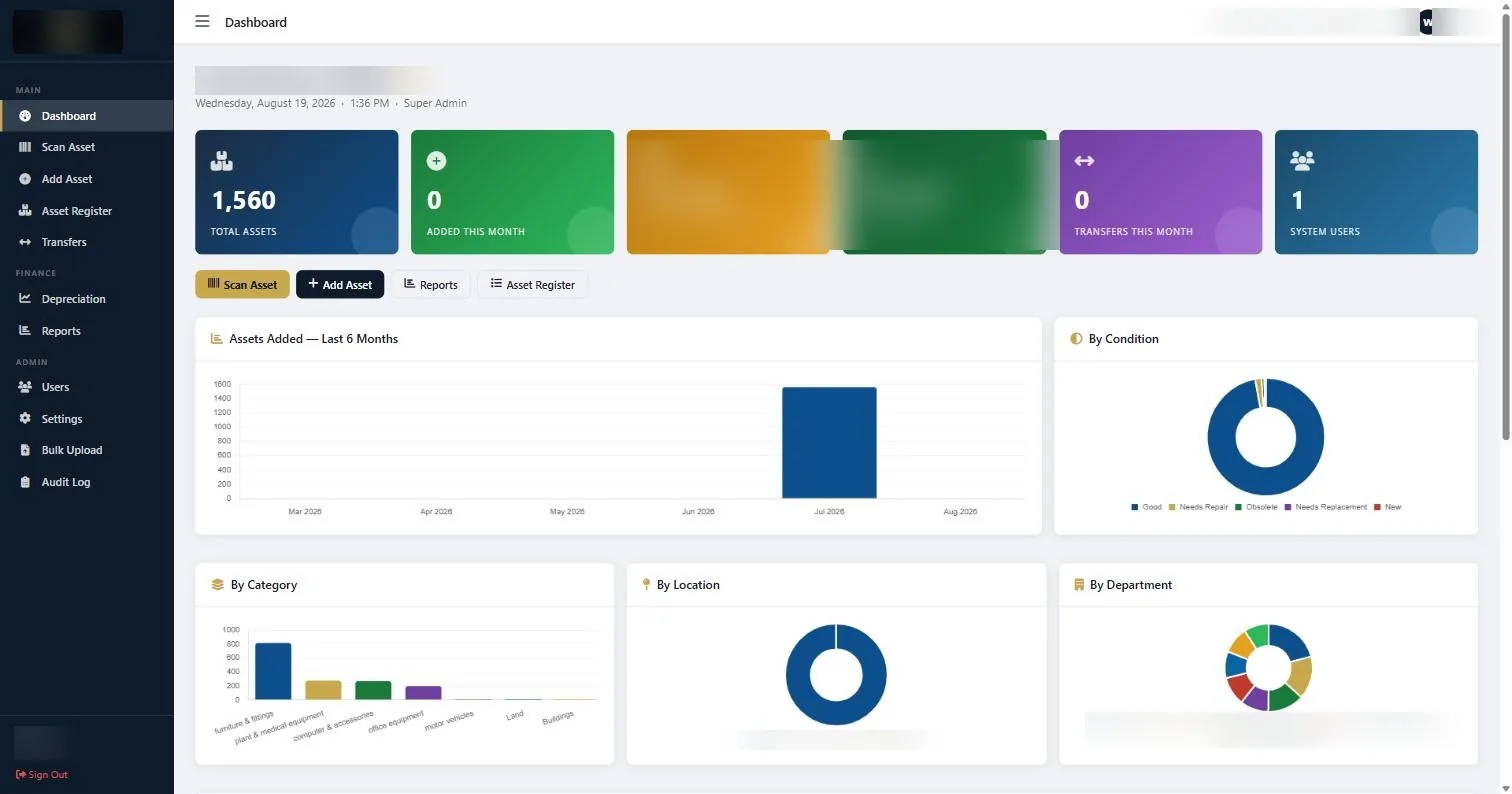
See how a structured register handles custodians, transfers, audits, maintenance, disposal and reporting in one place. Book an asset system demo →
Where the capitalisation decision sits
Maintenance spending splits into two kinds and the split has to be made when the invoice arrives, not at year end.
Work that maintains the asset in its existing condition is a repair and is expensed. Work that extends its life or capability beyond the originally assessed standard is generally capitalised and added to the asset.
A new engine, a major refurbishment or an upgrade that increases capacity typically falls on the capital side. Servicing, parts replacement and routine repairs typically do not. Write the rule into your asset policy and give maintenance a copy, because they are the ones who see the invoice first.
Using the register to plan replacement
Three reports, run together, give you a replacement plan without any additional system.
Fully depreciated but still in use. Assets whose accounting life has ended but which are still working. Useful for planning and a signal that useful lives may need reviewing.
Condition by category. Where the deterioration is concentrated.
Cumulative maintenance cost per asset. From the maintenance system, keyed on the shared asset number. When annual upkeep starts approaching replacement cost, the decision makes itself.
Together these turn replacement from a budget-cycle argument into an evidenced schedule.
Common questions about preventive maintenance
Should maintenance history live in the asset register?
A summary can. The detailed work order history belongs in the maintenance system, which is built for it. What the register needs is condition, capitalised improvements and out-of-service periods.
What if maintenance already has its own numbering?
Migrate to one shared number. Maintaining a mapping table between two schemes works until the person who understands it leaves.
Who owns condition data?
Maintenance generates it, the register owner ensures it reaches the register. Agreeing that handoff explicitly prevents condition data going stale.
Does this need system integration?
Usually not. A shared asset number and an agreed exchange of a few fields achieves most of the value without any technical project.
How does this help at audit?
Current condition data supports impairment assessment, and capitalised improvements traced to invoices support the carrying amount. Both are questions auditors ask.
What about assets under warranty?
Record warranty expiry in the register and make sure maintenance sees it. Repairs paid for on assets still under warranty are a small, steady and entirely avoidable loss.
If you are starting preventive maintenance from scratch, use the asset numbers that already exist on the tags rather than creating a second numbering scheme. Preventive maintenance and finance can share one identifier without sharing one system.
Continue with the right next guide
Turn the process into a controlled workflow
See how a structured register handles custodians, transfers, audits, maintenance, disposal and reporting in one place.