
What belongs in a fixed asset management policy
An asset management policy that nobody can find is worth nothing. This is the short list of what it has to state, in language a department head can act on. Most asset registers fail for want of two pages of written policy, not for want of software. This is what those two pages need to say, section by section, and the decisions each section forces you to make.
In this article
The asset management policy: the short version
- Two operational pages beat forty theoretical ones.
- Name people, not departments, for register ownership.
- State the capitalisation threshold as a number, with a short list of tracked exceptions below it.
- Require both a departure and a return record for temporary movements.
- Put asset handover on the HR exit checklist and cross-reference it from the policy.
Why a short policy beats a long one
Asset policies fail in two directions. Either they do not exist, so every decision is improvised and inconsistent, or they run to forty pages of accounting theory that nobody in stores or facilities will ever read.
The useful document is short, specific and operational. It names people, states thresholds as numbers, and describes what happens at each point in the asset lifecycle. If somebody in receiving cannot find their instruction in under a minute, the policy is not doing its job.
Section 1: Scope and definitions
State what the policy covers and what it does not. The boundary that causes most confusion is between fixed assets, consumables and stock, so define it explicitly.
Define what counts as one asset. Whether a desk and chair are one item or two, whether a computer and its monitor are separate, and how sets and components are treated. This single paragraph prevents a great deal of inconsistency during capture.
Section 2: Capitalisation threshold
A single figure, agreed with your accountant, above which items are capitalised and entered in the register.
Then a short list of exceptions: items below the threshold that are tracked anyway because they are portable and attractive, typically laptops, phones, tablets, tools and small medical devices.
State how the threshold applies to bulk purchases. Twenty chairs at a low unit price are usually expensed individually rather than capitalised as a batch, but organisations differ and it should be written down rather than argued about annually.
Section 3: Asset numbering and tagging
The numbering convention, with an example. Who allocates numbers. Which classes get which tag specification. Where the tag is fitted on each class.
Also the rule that matters most in practice: when a tag fails, the asset keeps its original number and receives a replacement tag. Nobody creates a new record.
Section 4: Roles and responsibilities
| Role | Responsible for |
|---|---|
| Register owner | Accuracy of the register, running verifications, producing reports. One named person. |
| Deputy | Everything the owner does, when the owner is unavailable. Also named. |
| Procurement or receiving | Notifying the register owner of every capital purchase at goods receipt. |
| Department heads | Confirming their asset list annually and reporting movements and losses. |
| Custodians | Care of assets issued to them and return on exit. |
| Finance | Categories, depreciation policy, capitalisation decisions, reconciliation to the ledger. |
Turn the process into a controlled workflow
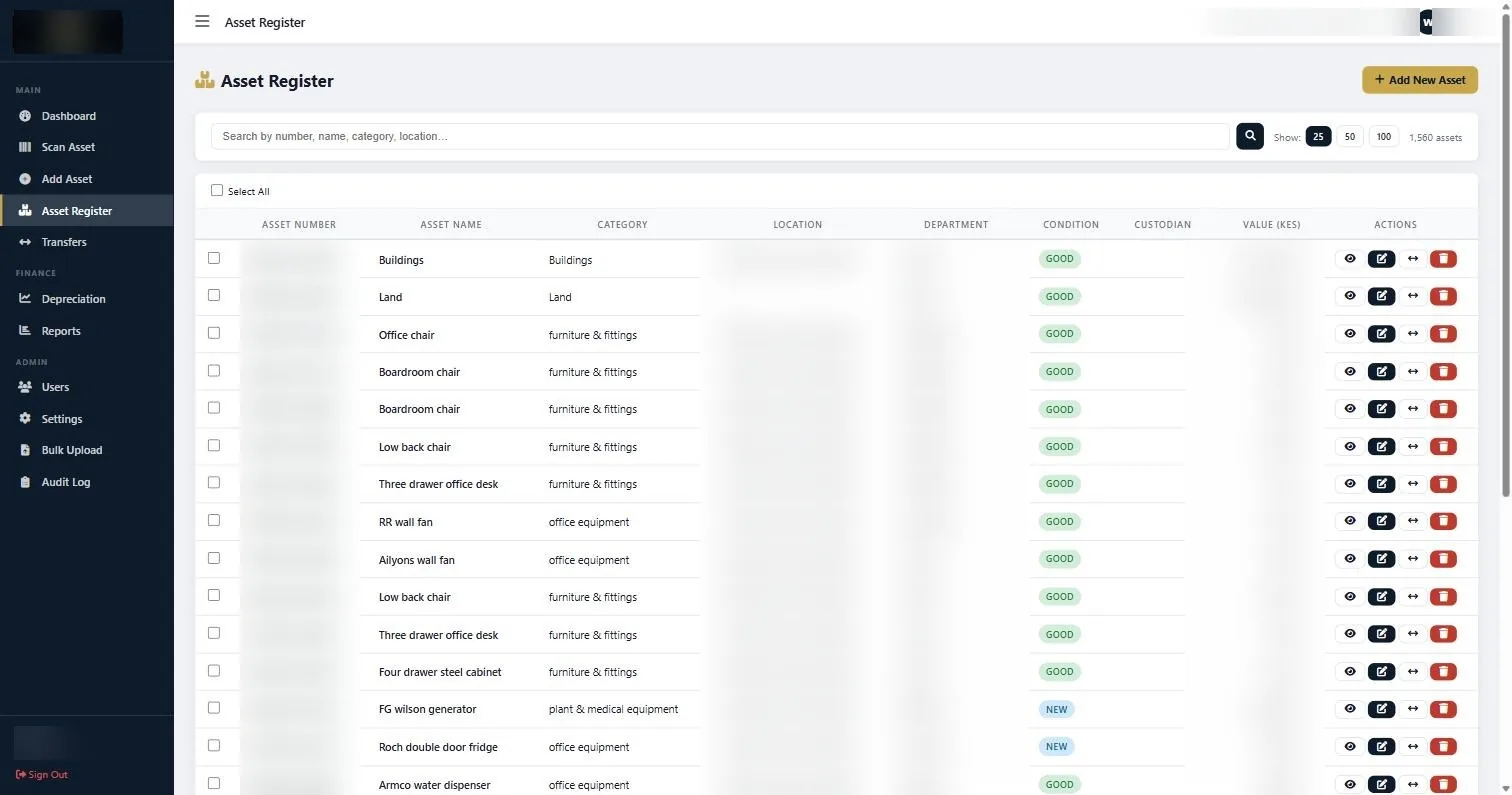
See how a structured register handles custodians, transfers, audits, maintenance, disposal and reporting in one place. Book an asset system demo →
Section 5: Movements and custody
State that no asset moves between locations, departments or people without a recorded transfer, and name who can authorise one.
Cover temporary movements explicitly: equipment out for repair, on loan to another site, or taken off site for an event. An open temporary movement with no return date is indistinguishable from a missing asset, so require both a departure and a return record.
Include the staff exit rule here, and cross-reference it from the HR exit checklist. Assets leaving with departing staff is the most common single source of unexplained loss, and it is entirely preventable with one line on a checklist.
Section 6: Verification
State the frequency, the timing relative to the financial year end, who runs it, and what the output is. Name the exception report as a required deliverable so that a verification producing no findings is visibly incomplete.
Include the rule that missing assets are not written off during the count. Give the follow-up window a stated length, usually two to four weeks, before anything goes to management.
Section 7: Disposal
Who authorises disposal, at what value thresholds, and by what methods. What documentation is required. How proceeds are recorded.
Two clauses that are frequently missing and frequently needed: data-bearing equipment must be wiped or physically destroyed before it leaves, with that step recorded against the asset; and donor-funded equipment may carry conditions on disposal that survive the project, so grant terms are checked before anything is sold or scrapped.
Section 8: Depreciation and review
The method and rate by category, agreed with your accountant, and the statement that useful lives and residual values are reviewed periodically rather than set once and forgotten.
This section belongs in the policy even though finance owns it, because the people entering assets need to know why category selection matters.
Common questions about asset management policy
Who should approve the policy?
Whoever approves financial policy in your organisation, typically the finance director or the board or council. It carries more weight when it is approved rather than circulated.
How often should it be reviewed?
Annually is conventional, but in practice the trigger is change: a new system, a new site, a restructure, or an audit finding. Review when something changes rather than only on a calendar.
Should the policy name specific software?
Better to describe what the system must do rather than name a product, so the policy survives a change of system.
What if departments ignore it?
That is usually a sign that it asks for something impractical or that nobody owns enforcement. Both are fixable, and both are more common than deliberate non-compliance.
Does STL provide a policy?
We provide the operational content that comes out of the tagging engagement, including numbering, tag specification and verification process. The accounting sections belong with your accountant.
Is a policy required for audit?
Not universally, but auditors will ask how a control operates, and a written policy is the fastest way to answer. Public sector bodies and donor-funded organisations are more often required to hold one.
Keep the asset management policy to a few pages and put the detail in procedures underneath it. A policy long enough to need a summary is one that will be ignored.
Continue with the right next guide
Turn the process into a controlled workflow
See how a structured register handles custodians, transfers, audits, maintenance, disposal and reporting in one place.