
Fixed asset depreciation: methods, useful life, and why your register decides the answer
Fixed asset depreciation arguments almost always turn out to be data arguments. The method is rarely wrong. The acquisition dates and costs behind it usually are. Depreciation is arithmetic and the arithmetic is never the problem. The inputs are. Here is how the methods work and where registers make the output wrong.
In this article
Fixed asset depreciation: the short version
- Accounting depreciation and tax capital allowances are different calculations that produce different values for the same asset.
- Ghost assets keep attracting depreciation against nothing. Unrecorded assets are never depreciated at all.
- Depreciation starts when an asset is available for use, not on the invoice date.
- Bulk register lines cannot be verified, partially disposed of, or depreciated accurately.
- Disposals must be recorded, or the register carries assets that left years ago.
Two different calculations, often confused
Before anything else, separate these, because conflating them causes most of the confusion in this area.
Accounting depreciation is how you spread an asset’s cost across the years it is used, so your financial statements reflect that a five-year machine is not a one-year expense. You choose the method and the useful life, guided by the applicable accounting standard, and it appears in your books and on your balance sheet.
Tax capital allowances are what the revenue authority permits you to deduct. The rules, rates and categories are set by tax legislation, not by you, and they frequently do not match your accounting treatment at all.
The consequence is that an asset can carry two different values simultaneously: a net book value in your accounts and a written-down value for tax. Both are correct. They answer different questions.
A note on rates
Capital allowance categories and rates in Kenya are set out in tax legislation and change from time to time. We deliberately do not quote figures here, because a stale rate in a blog post is worse than no rate. Confirm the current position with your accountant or directly with KRA. This article is about the mechanics and the register, which do not change.
The methods, and when each is appropriate
Straight line
Cost minus residual value, divided by useful life. The same charge every year. Simple, predictable, and appropriate for assets that deliver even value over time: furniture, fittings, buildings, most office equipment.
Reducing balance
A fixed percentage of the remaining book value each year, so the charge is heaviest early and tapers. Appropriate where an asset loses value fastest at the start, which is most vehicles and a lot of IT equipment.
Units of production
Depreciation driven by output or hours rather than time. Appropriate for machinery where wear tracks usage rather than the calendar. Underused, because it requires usage data most organisations do not capture.
| Asset type | Usually suits | Why |
|---|---|---|
| Buildings and structures | Straight line | Long life, even consumption of value |
| Furniture and fittings | Straight line | Predictable, gradual wear |
| Vehicles | Reducing balance | Steepest value loss in the first years |
| IT equipment | Straight line or reducing balance | Short life; obsolescence often outpaces wear |
| Plant and machinery | Straight line or units of production | Depends whether wear tracks time or output |
Why depreciation is only as good as your register
Depreciation is arithmetic. The arithmetic is never the problem. The inputs are.
Ghost assets. An asset disposed of three years ago but never written off is still being depreciated. You are charging cost against nothing, understating profit, and carrying a balance sheet value for something that does not exist. When an auditor tests existence and cannot find it, this is the finding.
Unrecorded assets. Equipment in daily use that never made it onto the register is not depreciated at all. Your asset base is understated and there is no cost recognition for something that is genuinely wearing out.
Wrong acquisition dates. Depreciation starts when an asset is available for use. If the register carries the invoice date, or the date somebody got round to entering it, every subsequent year is wrong by that offset.
Bulk lines. “Office furniture, 2022, KSh 1.4m” as a single line cannot be depreciated correctly, cannot be verified, and cannot be partially disposed of. It has to be broken into individual assets to behave properly.
None of these are depreciation problems. They are register problems that show up in the depreciation figures, which is why we verify before anything else.
Getting useful life right
Useful life is a judgement, and it should be the period you actually expect to use the asset, not a number copied from a template.
Three questions that usually settle it:
- When will we realistically replace this? Your own replacement history is better evidence than any published table.
- What ends its life, wear or obsolescence? A laptop is usually replaced because it is slow, not because it is broken. That shortens the honest useful life.
- What environment does it live in? The same pump in a covered plant room and outdoors do not have the same life.
Residual value is worth a moment too. For most office and IT equipment it is effectively nil. For vehicles and some machinery it is not, and assuming zero overstates the annual charge for years.
See the finance and depreciation workflow
Book a focused demonstration using your own workflow questions, including registers, custodians, transfers, audits and depreciation. Book a finance team demo →
Doing it in practice
Depreciation across a handful of assets is a formula. Across several hundred, in different categories, acquired on different dates, with mid-year disposals and additions, maintaining it by hand is where errors accumulate unnoticed.
What a system should give you:
- Depreciation calculated per asset from its own category, cost and acquisition date, not applied in bulk.
- Net book value visible per asset and in total, current at any moment rather than at year end.
- A depreciation schedule you can export and hand to an auditor.
- Quarterly views, because that is the rhythm most finance teams actually report on.
- Correct handling of additions and disposals part-way through a period.
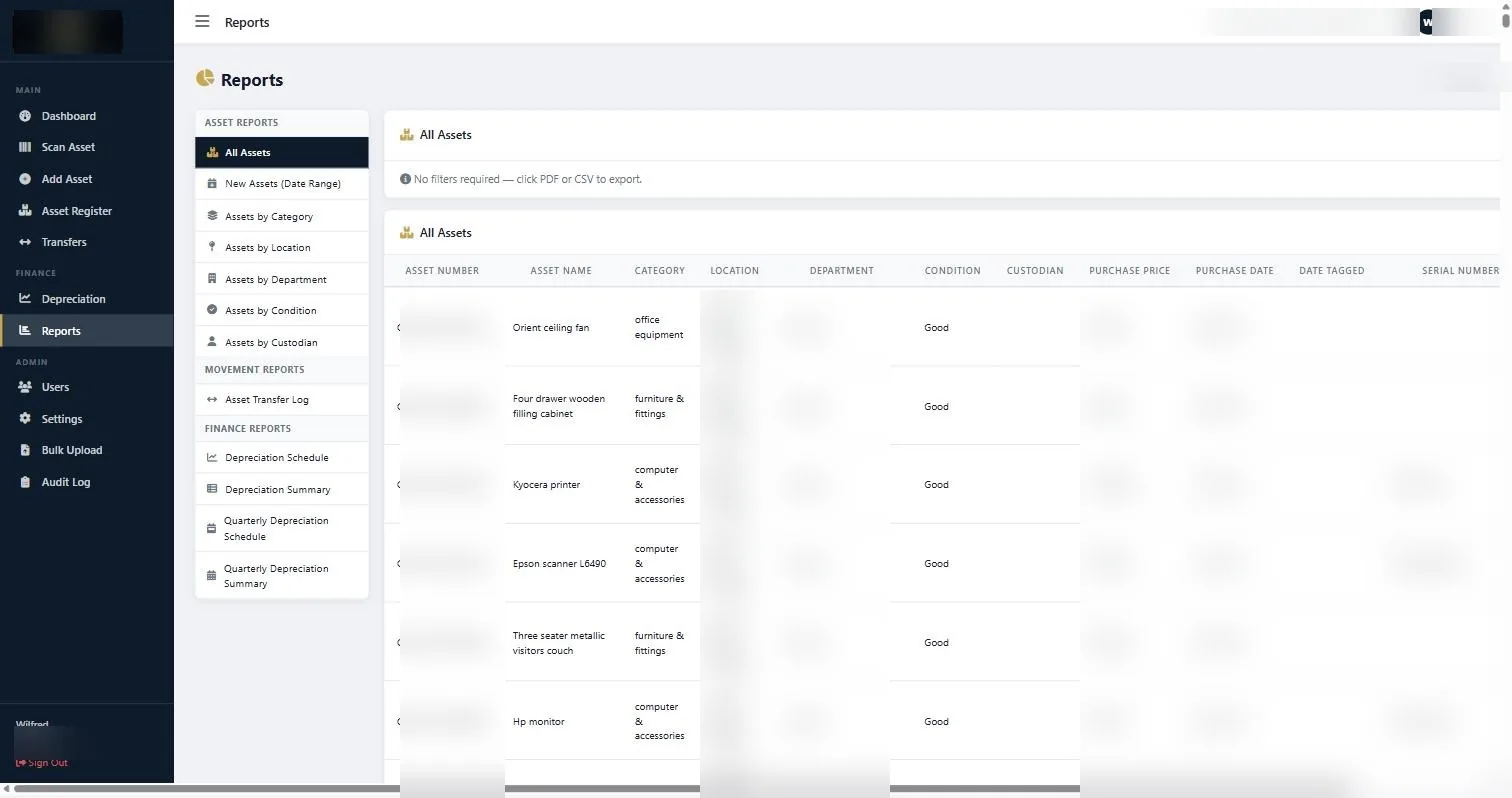
Our asset management system produces depreciation schedules and summaries, including quarterly, exportable as CSV or PDF. The value of that is not the arithmetic; it is that every line ties back to an asset carrying a scannable tag, so the figure is defensible rather than asserted.
Disposals, the step everyone skips
When an asset leaves, three things have to happen: it is removed from the register, the accumulated depreciation is reversed out, and any gain or loss on disposal is recognised.
In practice the asset leaves and none of the three happen, usually because nobody owns the step. The result is a ghost asset that quietly distorts every subsequent year.
Make disposal a recorded event with evidence attached, in the same way you would treat an acquisition. If an asset is being scrapped, sold, donated or written off after theft, the register should show it and the reason.
A short checklist before year end
- Confirm every asset on the register physically exists. Anything that cannot be located is a disposal or an investigation, not a rounding difference.
- Add anything in use that is not on the register, with a realistic acquisition date and cost.
- Break bulk lines into individual assets.
- Check acquisition dates reflect availability for use, not invoice date.
- Review useful lives against your actual replacement history.
- Record every disposal, with the reason and evidence.
- Reconcile the register total to the balance sheet before the auditors do.
If step one is the hard part, that is the normal position and it is what tagging solves. See how the tagging service works or the fixed asset audit checklist.
This article is general information about how depreciation and asset registers interact. It is not accounting or tax advice, and we are not accountants or tax advisers. Confirm treatment, rates and categories with your own accountant or with KRA.
Common questions about fixed asset depreciation
What is the difference between depreciation and capital allowances in Kenya?
Depreciation is an accounting figure: you choose the method and useful life, and it appears in your financial statements. Capital allowances are a tax deduction with categories and rates set by tax legislation. They routinely produce different values for the same asset, and both are correct for their own purpose.
Which depreciation method should I use?
Straight line for assets that deliver even value over time, such as furniture and buildings. Reducing balance where value falls fastest early, such as vehicles. Units of production where wear tracks output rather than time. The method should reflect how the asset is actually consumed.
What is a ghost asset and why does it matter for depreciation?
An asset on the register that no longer physically exists. It continues attracting a depreciation charge against nothing, overstates your balance sheet, and is one of the two standard audit findings on fixed assets. Physical verification is the only way to find them.
When does depreciation start?
When the asset is available for use, not when it was invoiced or when somebody entered it into the system. Registers that carry the wrong date get every subsequent year wrong by that offset, which is a common and easily avoided error.
Can I depreciate a group of assets as one line?
You can, and it causes problems. A bulk line cannot be physically verified, cannot be partially disposed of, and cannot be depreciated accurately when items were acquired at different times. Splitting bulk lines into individually identified assets is usually part of a tagging project.
Does asset management software calculate depreciation?
Ours does, per asset from its own category, cost and acquisition date, with schedules and quarterly summaries exportable as CSV or PDF. The arithmetic is the easy part; the value is that each line ties back to a physically verified, tagged asset.
Before you change a fixed asset depreciation method, check how many assets are carried at a cost nobody can substantiate. Fixing that usually moves the number more than the method change would.
Continue with the right next guide
See the finance and depreciation workflow
Book a focused demonstration using your own workflow questions, including registers, custodians, transfers, audits and depreciation.