
Fixed asset audit checklist: what auditors test and how to be ready
A fixed asset audit checklist is most useful before the auditors arrive, because every item on it is something you can still fix in the weeks beforehand. Five assertions, five recurring findings, and a checklist you can work through before anyone arrives. Plus why tagging changes what the test itself looks like.
In this article
The fixed asset audit checklist: the short version
- Existence and completeness are tested in opposite directions. Passing one says nothing about the other.
- The most common finding is an asset on the register that cannot be found, almost always an unrecorded disposal.
- Depreciation that cannot be recalculated from the register is a finding regardless of whether the number is right.
- Having no evidence that verification was performed is itself a control point.
- Tagging turns existence testing from a debate about descriptions into a scan that matches or does not.
What auditors actually test
Fixed asset audit work is narrower than most people expect. Auditors are testing a small number of assertions, and almost every finding traces back to one of them.
| Assertion | The question | How it is tested |
|---|---|---|
| Existence | Does this asset actually exist? | Pick items from the register, go and find them |
| Completeness | Is everything you own on the register? | Pick items on the floor, find them on the register |
| Rights and obligations | Do you actually own it? | Invoices, titles, logbooks, lease agreements |
| Valuation | Is it carried at the right amount? | Recalculate depreciation, check cost to source documents |
| Presentation | Is it classified and disclosed correctly? | Category review, note disclosures |
Note that the first two are tested in opposite directions. That is deliberate, and it is why an organisation can pass one and fail the other. A register can be entirely composed of assets that exist and still be missing half your estate.
Before the auditors arrive
Physical verification
- Every asset on the register located and confirmed within the last twelve months.
- Anything not located investigated and resolved, as a disposal, a transfer or a loss, not left as an open question.
- A walk of each site to find assets in use that are not on the register.
- Bulk lines broken into individually identified assets.
- Every asset carrying a unique, readable identifier that maps to a register entry.
Register integrity
- Unique asset number on every line, with no duplicates.
- Description specific enough to identify the item, not “laptop”.
- Serial numbers captured where the manufacturer provides one.
- Category, location, department and custodian populated on every line.
- Acquisition date reflecting availability for use, not invoice date.
- Cost traceable to an invoice or other source document.
Valuation
- Depreciation calculated per asset by category, not estimated in bulk.
- Useful lives reviewed against actual replacement history.
- Additions during the period recorded with correct dates.
- Disposals removed from the register, with accumulated depreciation reversed and gain or loss recognised.
- Register total reconciled to the general ledger.
Documentation
- Invoices for additions available.
- Ownership documents for vehicles and property.
- Disposal evidence: approvals, sale documents, scrapping records, police reports where relevant.
- Prior year audit points and what was done about them.
The five findings that recur
1. Asset on the register could not be located
The existence failure. Usually a disposal that was never recorded. It inflates the balance sheet and attracts depreciation on nothing.
2. Asset in use not on the register
The completeness failure. Understates asset value and means there is no claim if it is lost. Common with items bought outside the normal procurement route or below the capitalisation threshold.
3. Register does not reconcile to the ledger
The two are maintained separately and drift apart. Frequently the register is right and the ledger has bulk entries that were never broken down.
4. Depreciation cannot be recalculated
Because the register lacks acquisition dates, per-asset costs, or a consistent category-to-life mapping. The auditor cannot verify a number they cannot reconstruct.
5. No evidence of periodic physical verification
This one is about process rather than data. Even a clean register attracts a control point if there is no record of anyone having checked it.
Why tagging changes the audit itself
Consider what an existence test looks like in each world.
Without tags. The auditor picks line 340, “Dell laptop, IT department”. Someone walks to the IT department. There are eleven Dell laptops. Which one is line 340? The conversation moves to serial numbers, and then to whether the serial on the register was recorded correctly. This takes a long time and settles nothing conclusively.
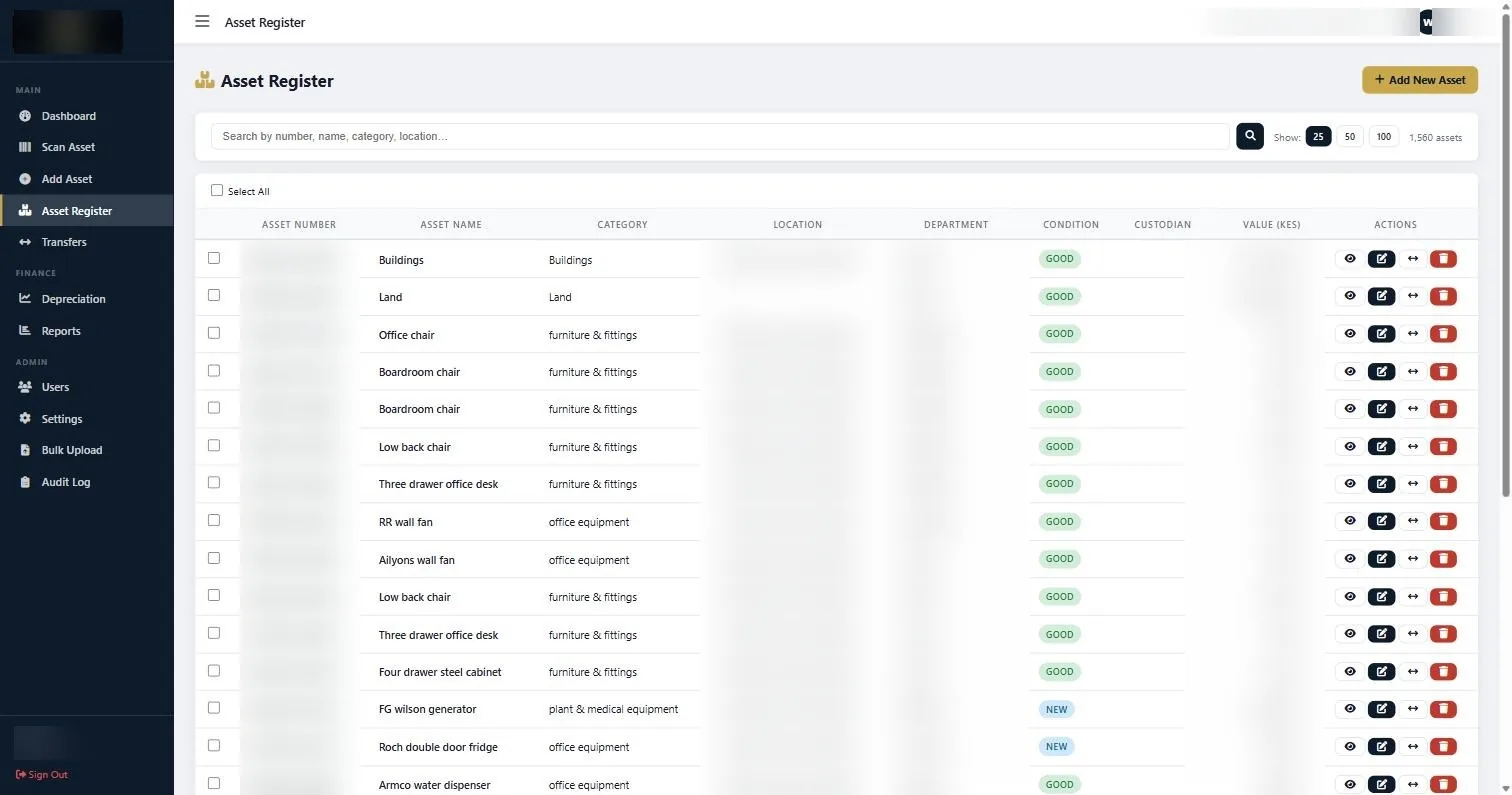
With tags. The auditor picks line 340, reads the asset number, and someone scans tags until it matches. It takes seconds and the result is unambiguous.
The same applies in the other direction. Completeness testing without tags means describing an object and searching a spreadsheet for something that might be it. With tags, the object tells you its own register line.
This is why organisations with recurring fixed asset findings usually stop having them after one tagging exercise. Not because the assets changed, but because the evidence became checkable.
Book an asset verification assessment
Send your current register and approximate asset count. We will identify the practical steps needed to verify, reconcile and tag the assets. Request a verification assessment →
What a clean position looks like
On the Kenya Dairy Board project, the starting point was a register that existed and looked complete across 20-plus branches. The work was verifying it line by line, removing what was gone, adding what had never been recorded, and only then printing more than 5,000 tags against something true. The deliverable was not tags; it was a register that could survive being tested.
For Hennet, an NGO with around 600 assets, the same logic applied for a different reason: donor reporting. When funders can ask you to demonstrate that a specific funded item still exists and is in use, a spreadsheet row is an assertion and a scannable tag is evidence.
If the auditors are already on site
You cannot fix a year of drift in a week, but you can improve the position and, more importantly, the conversation.
- Reconcile the register to the ledger first. An unreconciled position invites questions on everything else.
- Verify the high-value lines. Sampling is usually weighted by value. Confirm the top of the register exists.
- Record the disposals you know about. A recorded disposal with a reason is a normal transaction. An unexplained absence is a finding.
- Be straight about the gaps. Auditors respond far better to “we know the furniture register is incomplete and here is our plan” than to a defence that does not hold under testing.
- Get the remediation plan in writing. A dated plan converts a finding into a management response, which is a much better place to be next year.
When you are ready to close the gap properly, the sequence is on the tagging service page, and the cost drivers are in what asset tagging costs.
This is general guidance on preparing a fixed asset register for audit, not audit or accounting advice. Your auditors’ scope and requirements take precedence.
Common questions about fixed asset audit checklist
What do auditors check on fixed assets?
Primarily existence (does an asset on the register physically exist), completeness (is everything you own on the register), ownership, valuation including depreciation, and classification. Existence and completeness are tested in opposite directions, which is why organisations can pass one and fail the other.
How often should we do a physical asset verification?
At least annually. Short verification walks by department each quarter work better in practice, because they catch drift while it is small rather than presenting a year of accumulated errors at once.
What is the most common fixed asset audit finding?
Assets on the register that cannot be located, almost always because a disposal was never recorded. The second most common is the reverse: equipment in daily use that was never added to the register.
Does asset tagging help with audits?
Substantially. It turns existence testing from an argument about descriptions and serial numbers into a scan that either matches or does not. It also gives you evidence that verification was performed, which is a control point in its own right.
What documents should we have ready for a fixed asset audit?
Invoices for additions, ownership documents for vehicles and property, disposal evidence including approvals and sale or scrapping records, the depreciation schedule, the register to ledger reconciliation, and evidence of your last physical verification.
Our register does not reconcile to the ledger. Where do we start?
Start with the register, not the ledger. Verify what physically exists, build the register from that, then explain the difference. Adjusting the register to match a ledger you have not tested just moves the error.
Work through the fixed asset audit checklist in the order given. Existence fails more audits than valuation does, and it is also the item that takes longest to put right.
Continue with the right next guide
Book an asset verification assessment
Send your current register and approximate asset count. We will identify the practical steps needed to verify, reconcile and tag the assets.