
Fixed asset register versus asset inventory
Fixed asset register vs asset inventory is not a naming argument. One is an accounting record and the other is an operational list, and using either for the other job causes real problems. An inventory tells you what is in the building. A register tells you what the organisation owns, what it cost, who is accountable for it and what it is worth today. Confusing the two is why some organisations pay for a count and end up unable to use it.
In this article
Fixed asset register vs asset inventory: the short version
- An inventory answers what is here. A register answers what we own, at what value, held by whom.
- Quantity lines are the clearest sign you have an inventory rather than a register.
- Unique identity per item is the change that makes everything else possible.
- Inventories are the right tool for stock, pre-move surveys and scoping.
- The test: can you walk from one line to one object, and from that object to a cost and a date?
The distinction in one table
| Asset inventory | Fixed asset register | |
|---|---|---|
| Answers | What is here? | What do we own, at what value, held by whom? |
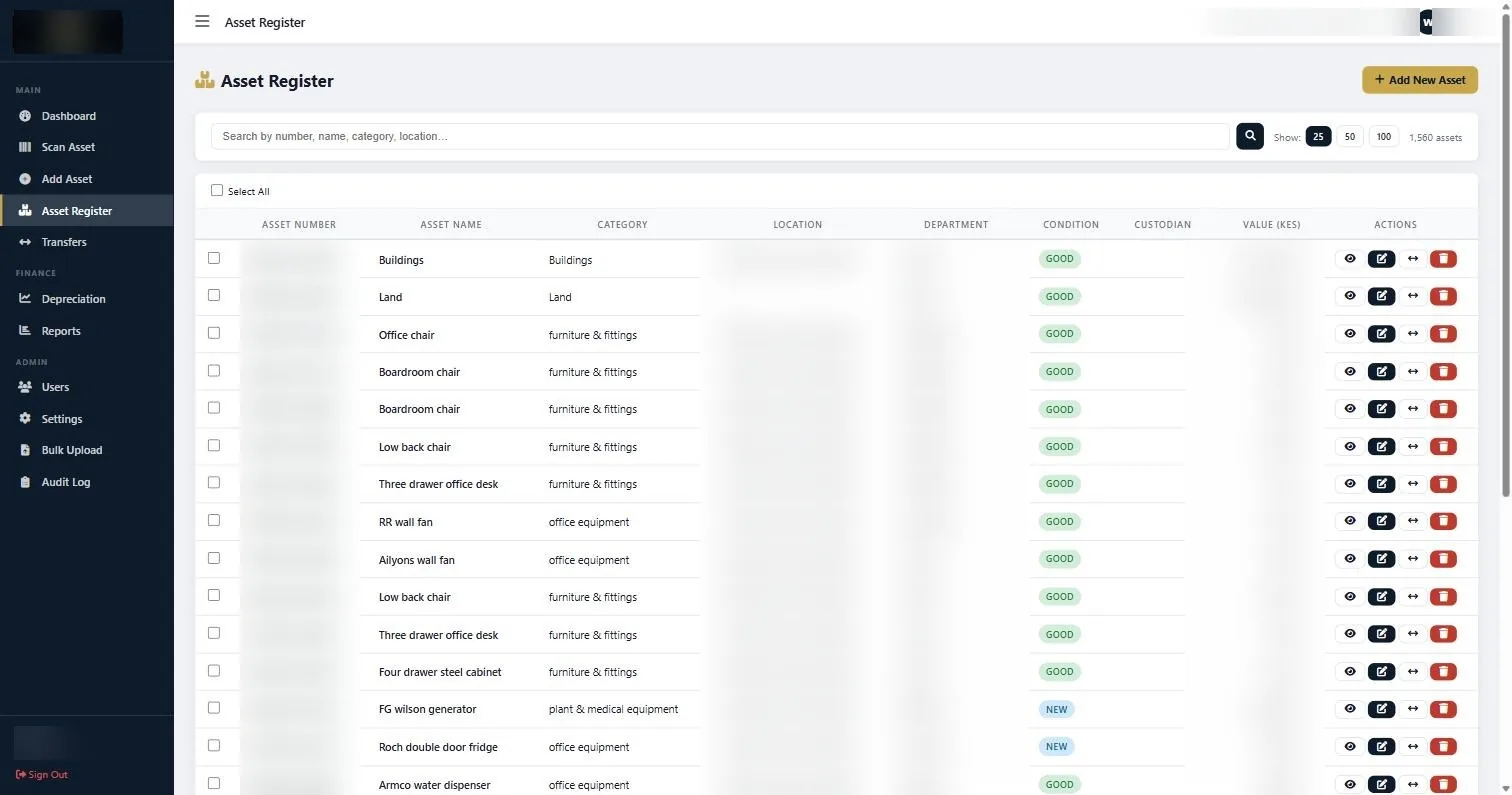
| Typical fields | Description, location, quantity | Unique number, description, category, location, department, custodian, condition, cost, acquisition date, depreciation, disposal |
| Unique identity | Often not. Ten chairs may be one line. | Always. Every asset has its own number. |
| Financial use | None directly | Depreciation, net book value, impairment, insurance, disposal accounting |
| Audited | Rarely | Yes, and substantively tested |
| Lifespan of a line | Until the next count | From acquisition to disposal, then retained as history |
Why organisations end up with an inventory when they wanted a register
It usually happens for one of three reasons.
The count was scoped as a count. Somebody asked for an inventory of the building, got exactly that, and then discovered finance could not use it because there are no costs, no dates and no unique identifiers.
Quantities were recorded instead of items. A line reading chairs, open plan, 42 is an inventory line. It cannot be depreciated individually, it cannot be assigned to a custodian, and when 39 are found next year nobody knows which three are missing.
Financial fields were left for later. Cost and acquisition date are the fields most often skipped during capture because they require finance input. Filling them afterwards means going back to procurement records asset by asset, which costs more than capturing them would have.
What turns an inventory into a register
Four additions, in order of difficulty.
1. A unique identifier per item. Not per line. This is what tagging provides and it is the change that makes everything else possible.
2. Category, in the finance sense. Not a descriptive grouping, but the class that determines depreciation treatment and the account the asset sits in.
3. Cost and acquisition date. Sourced from procurement records where they exist, and from a documented estimate agreed with your accountant where they do not.
4. Custodian and condition. The two fields that turn a financial record into an accountability record.
When an inventory is the right thing to buy
It is not always the poor relation. There are situations where an inventory is exactly what is needed and a register would be over-engineering.
- Consumables and stock. These are not fixed assets. They belong in stock control, counted by quantity.
- Pre-move surveys. Knowing what has to be transported does not require depreciation.
- Insurance schedules for low-value contents, where cover is written by category and location rather than per item.
- A rapid scoping exercise before a full tagging project, to size the work.
The mistake is not buying an inventory. It is buying an inventory and expecting it to satisfy an auditor.
Book an asset verification assessment
Send your current register and approximate asset count. We will identify the practical steps needed to verify, reconcile and tag the assets. Request a verification assessment →
The test to apply before you commission the work
Ask one question of whatever is being proposed: can somebody take a single line from this document and walk to the exact physical object it describes, then take that object and find its cost and its acquisition date?
If yes, you are commissioning a register. If no, you are commissioning an inventory, which may still be useful but will not support the accounts.
Getting from one to the other without starting again
If you already hold a good inventory, you are further along than you think. The sequence is: assign unique numbers, tag the physical assets to match, split quantity lines into individual items, then populate the financial fields from procurement records.
Splitting quantity lines is the tedious part and it has to be done physically, because deciding which of the 42 chairs is which can only happen in the room. That is the moment the inventory becomes a register, and it is why the physical exercise cannot be skipped.
Common questions about fixed asset register vs asset inventory
Is a spreadsheet a register?
It can be, if it has the fields and the discipline behind it. Most spreadsheets in practice are inventories with a few financial columns added and no unique identifiers.
Do we need both?
Usually one register plus separate stock control for consumables. Running two overlapping asset lists is how organisations end up with two versions of the truth.
Can we convert our inventory without re-tagging?
Only if every item already has a unique identifier attached to it. If the inventory counts quantities, the physical split has to happen on site.
Which does an insurer want?
Insurers vary. Contents cover is often written by location and category, which an inventory supports, but claims on individual high-value items go far more smoothly with a register.
What about IT asset management tools?
They hold a technical inventory of devices, which is useful, and they are not a fixed asset register. Where both exist, they should share the same asset numbers.
How long does the conversion take?
It is essentially a tagging project, so plan it as one. The existing inventory reduces the survey effort but not the physical work.
If you only maintain one of them, maintain the register and derive the inventory from it. Going the other way, fixed asset register vs asset inventory becomes a reconciliation exercise every single year.
Continue with the right next guide
Book an asset verification assessment
Send your current register and approximate asset count. We will identify the practical steps needed to verify, reconcile and tag the assets.