
Asset tagging and verification: two jobs, and why the order matters
Asset tagging and verification get quoted as one line item and are actually two jobs, and the order you do them in decides how much of the work you pay for twice. Verification establishes what is true. Tagging keeps it true. Doing them in the wrong order produces orphan tags, improvised numbering and a register that is harder to reconcile than before.
In this article
Asset tagging and verification: the short version
- Verification finds the truth. Tagging preserves it. Both are needed, in that order.
- Verification must work in both directions: register to floor, and floor to register.
- Expect the true asset count to run 20 to 40 percent above the existing register.
- Tagging first produces orphan tags for ghost assets and improvised numbers for unrecorded ones.
- Once tagged, verification becomes cheap enough to run quarterly rather than dreaded annually.
Two words, two different jobs
People use these interchangeably and they should not, because getting the order wrong is the most expensive mistake in this area.
Verification is establishing the truth. Walking the estate, confirming what physically exists, finding what was never recorded, removing what left years ago. It produces a register you can believe.
Tagging is attaching a permanent, unique, machine-readable identity to each of those confirmed assets. It produces a register you can keep believing.
Verification without tagging gives you a snapshot that starts decaying immediately. Tagging without verification gives you scannable labels on a list that was already wrong. You need both, in that order.
What verification actually involves
Walking, not sampling
A verification exercise covers the estate rather than testing a sample of it. Sampling is what auditors do to form an opinion. Verification is what you do to establish the facts they will test.
Working in both directions
Register to floor: take each recorded asset and find it. This surfaces ghost assets, items that no longer exist.
Floor to register: take each physical item and find its record. This surfaces unrecorded assets, and it is the direction people skip.
Both are necessary because they fail independently. A register composed entirely of assets that exist can still be missing half your estate.
Recording condition and location as found
Not as expected. If a projector recorded in the boardroom is actually in a storeroom, the register is updated to reflect where it is, and the discrepancy is noted rather than silently corrected.
Resolving, not deferring
Anything that cannot be located goes into an exception list and is worked through: transferred to another site, recorded twice under different numbers, disposed of without a record, or genuinely lost. Each has a different resolution. Leaving them unresolved is how the same difference reappears every year.
What comes out of it
| Output | What it tells you |
|---|---|
| Confirmed assets | Present, identified, matched to a register line. The base you keep |
| Ghost assets | On the register, not present. Candidates for write-off after investigation |
| Unrecorded assets | Present, not on the register. Additions, with a cost and date to establish |
| Misplaced assets | Present, but not where the register says. Location corrections and often a transfer process problem |
| Condition exceptions | Present but unusable. Impairment or disposal candidates |
| Duplicates | One physical asset recorded twice, usually after a system migration |
In our experience the true asset count comes out 20 to 40 percent above what the existing register showed. That figure surprises people the first time and stops surprising them afterwards.
Why the order is not negotiable
Consider what happens if you tag first.
You print tags from the existing register. Somewhere in that batch are tags for assets disposed of in 2022. Nobody can apply those, so they sit in a box. Meanwhile the team encounters equipment with no tag, because it was never on the register, and either skips it or improvises a number outside the scheme.
At the end you have a partially tagged estate, a set of orphan tags, and a register that is now harder to reconcile than before, because the tagging exercise has become a second source of truth.
Verifying first costs the same days. It just puts them at the start, where they change what gets printed.
The sequence
Verify what exists. Reconcile the register against it. Design the numbering. Print. Apply and record. Then run it.
Book an asset verification assessment
Send your current register and approximate asset count. We will identify the practical steps needed to verify, reconcile and tag the assets. Request a verification assessment →
How tagging changes verification from then on
The first verification is the expensive one because it is done without tags. Every subsequent one is a different exercise.
Without tags: read a description, look for a matching object, check a serial number, decide whether it is the same item, move on. Two people verifying the same room reach different answers.
With tags: scan, match, move on. The output is a list of exceptions rather than an opinion, and the exceptions are unambiguous.
This is why organisations often move from a dreaded annual count to short quarterly walks by department. The activity becomes cheap enough to do more often, which catches drift while it is still small.
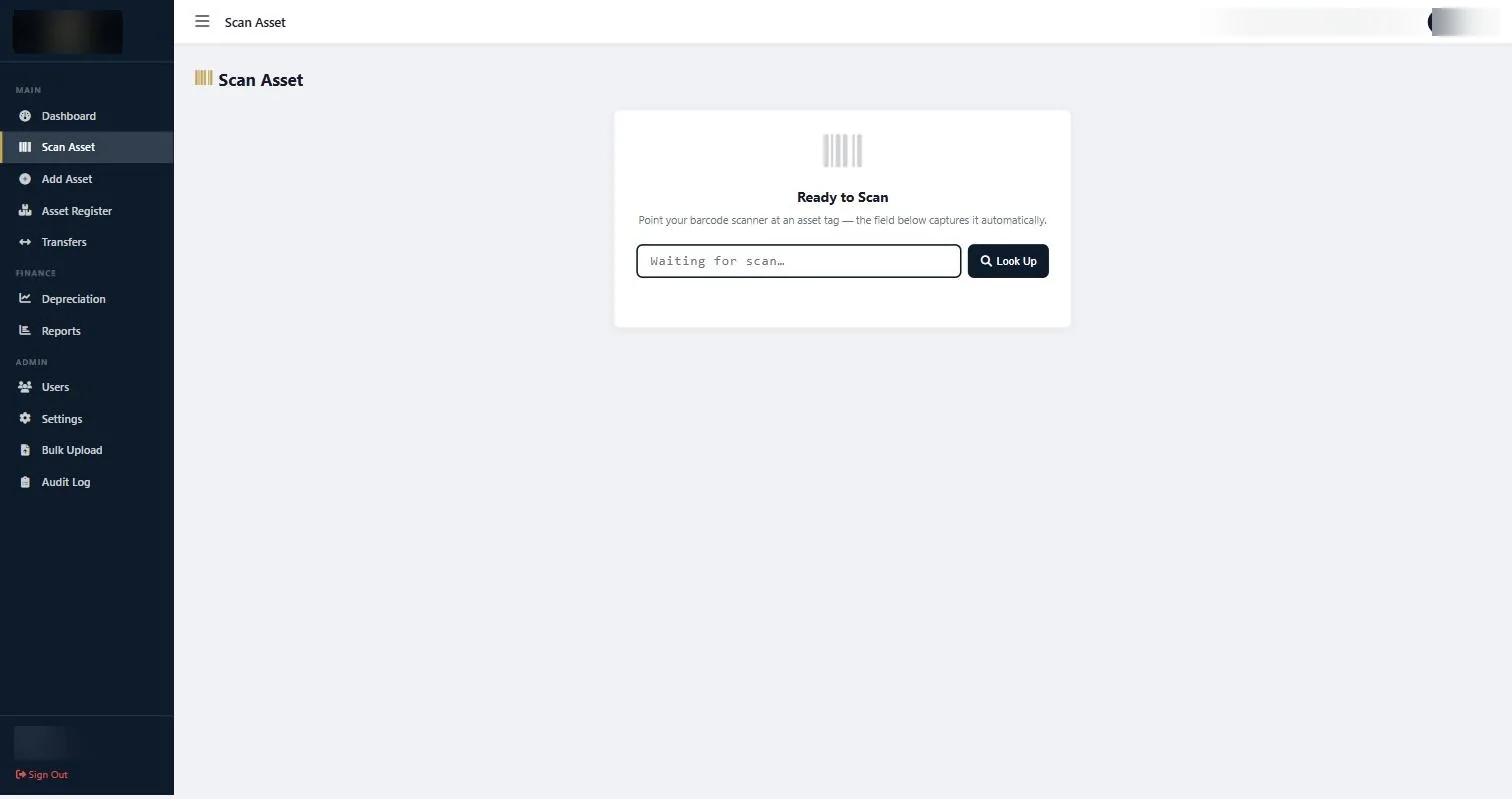
Our asset management system has a Scan Asset screen that pulls up a record from a barcode reader, which is what makes this practical rather than theoretical.
What this looked like on real projects
Kenya Dairy Board is the clearest example of verification-led work. A register already existed across 20-plus branches and looked complete. The job was testing it line by line, cleaning it, and only then tagging more than 5,000 assets against something true. The tags were the last step, not the first.
Thika Water and Sewerage Company, over 2,000 assets across seven branches, added a second dimension: verification also established what environment each asset lived in, which is what determined tag material. You cannot specify tags correctly without having seen the assets.
Pax Manor ran verification across hotel departments for more than 3,000 fixed assets alongside an inventory count of over 10,000 items, which is a useful reminder that fixed assets and inventory need separate treatment even when they are counted in the same visit.
Keeping it verified
Verification is not a project you complete. It is a state you maintain.
- Log transfers as they happen. Most drift is untracked movement, not loss.
- Record disposals as transactions. With a reason and evidence, not by deleting a row.
- Add new assets on arrival, tagged before deployment rather than at the next count.
- Run short verification walks by department quarterly. An hour per department beats a week once a year.
- Investigate exceptions immediately. A missing asset found in week two is a question. Found eleven months later it is an archaeology exercise.
If you want to see what a full exercise involves at your scale, the process and pricing drivers are on asset tagging in Kenya and what asset tagging costs.
Common questions about asset tagging and verification
What is the difference between asset tagging and asset verification?
Verification establishes what physically exists and corrects the register to match. Tagging attaches a unique machine-readable identity to each confirmed asset so the register stays checkable. Verification comes first; tagging against an unverified register just makes wrong data scannable.
How long does an asset verification take?
It depends on asset count, number of sites and how far the existing register has drifted. The physical walking is predictable; resolving exceptions is what varies, and that is driven by record quality rather than asset numbers.
Do we need to verify every asset or is a sample enough?
Sampling is what auditors do to form an opinion on a register. Verification is what you do to make the register true, and that means covering the estate rather than testing part of it. A sample tells you roughly how wrong you are, not what to fix.
What if we find assets that were never recorded?
That is the expected outcome, and it is why verification works in both directions. Unrecorded assets are captured, numbered, tagged and added with a cost and acquisition date established as accurately as the evidence allows.
How often should verification be repeated?
Annually as a minimum. Once assets are tagged, short quarterly walks by department are more effective, because scanning makes the exercise cheap enough to do more often and catches drift while it is still small.
Can we do verification ourselves?
Yes, and some organisations do. The parts that go wrong when done in-house are working in only one direction (register to floor), deferring exceptions rather than resolving them, and correcting the register silently so nobody learns why it drifted.
If a supplier quotes asset tagging and verification as a single undifferentiated price, ask them to split it. The split tells you whether they intend to verify at all.
Continue with the right next guide
Book an asset verification assessment
Send your current register and approximate asset count. We will identify the practical steps needed to verify, reconcile and tag the assets.