
What is fixed asset management, and why do registers drift?
What is fixed asset management, in one sentence: knowing what you own, where it is, who holds it and what it is worth, and being able to prove all four. Four things a register has to do, the two lifecycle stages where it usually breaks, and why drift is structural rather than a discipline problem.
In this article
What is fixed asset management: the short version
- Fixed assets have individual identity. That is what separates them from inventory and makes the discipline distinct.
- A register must answer what you own, where it is, what it is worth and what state it is in.
- Transfer and disposal are the two lifecycle stages that cause most register drift.
- Drift is structural: the people who move assets are not the people who maintain records.
- Tagging connects the record to the object. Verification comes before tagging, always.
What counts as a fixed asset
A fixed asset is something your organisation owns, uses to operate, and expects to still have in more than a year. Buildings, vehicles, machinery, IT equipment, furniture, fittings.
The distinction that matters day to day is not the accounting definition but the practical one: a fixed asset has an identity. There is a specific laptop, a specific generator. Contrast that with inventory or consumables, which are tracked by quantity. You do not care which box of paper you took, only how many are left. You care very much which laptop went missing.
That difference in identity is what makes fixed asset management a distinct discipline. Once each item has to be individually accounted for, the tools that work for stock stop working.
The four things fixed asset management has to do
1. Know what you own
A complete list, individually identified, physically confirmed. Sounds trivial and almost never is. Most registers have both ghost assets, recorded but gone, and unrecorded assets in daily use.
2. Know where it is and who has it
Location, department, custodian. This is the part that goes stale fastest, because assets move through normal operational events that nothing forces you to record.
3. Know what it is worth
Acquisition cost, accumulated depreciation, net book value. This is what feeds your balance sheet, your insurance declaration and your replacement planning.
4. Know what state it is in
Condition, maintenance history, expected remaining life. This turns replacement from a reaction into a plan.
Any system that does the first two and not the last two is an inventory. Any system that does the last two without the first two is arithmetic on assumptions.
The lifecycle, and where it usually breaks
| Stage | What should happen | What usually happens |
|---|---|---|
| Acquisition | Asset recorded with cost, date, category and custodian, and tagged on arrival | Recorded in the ledger only, sometimes months later, never tagged |
| Deployment | Location and custodian assigned and logged | Handed to whoever needed it |
| Transfer | Movement logged with date, from, to and reason | Nothing recorded; the register still shows the old holder |
| Maintenance | Service events recorded against the asset | Recorded by the maintenance team in a separate system, if at all |
| Verification | Periodic physical confirmation against the register | An annual count nobody fully trusts |
| Depreciation | Calculated per asset by category and useful life | Estimated in bulk, or maintained by hand in a spreadsheet |
| Disposal | Written off, removed from the register, evidence retained | Asset physically gone, still on the books, still depreciating |
Two stages account for most of the damage: transfer and disposal. Both are events that happen quietly and neither leaves a natural paper trail.
Why the register drifts even when everyone is competent
Nobody sets out to keep bad records. Drift is structural.
The people who move assets are not the people who maintain the register. A department head reassigns a laptop. Finance owns the register. There is no moment where those two facts meet unless something forces them to.
Updating is harder than not updating. If logging a transfer means finding a spreadsheet, locating the right row, editing without conflicting with a colleague’s copy, and saving somewhere agreed, it will not survive a busy week.
Nothing fails visibly. A wrong register produces no error message. It just quietly stops being true, and the gap only surfaces at audit.
The fix is not discipline. It is making the correct action cheaper than the incorrect one: a tag you scan and a record that opens.
Turn the process into a controlled workflow
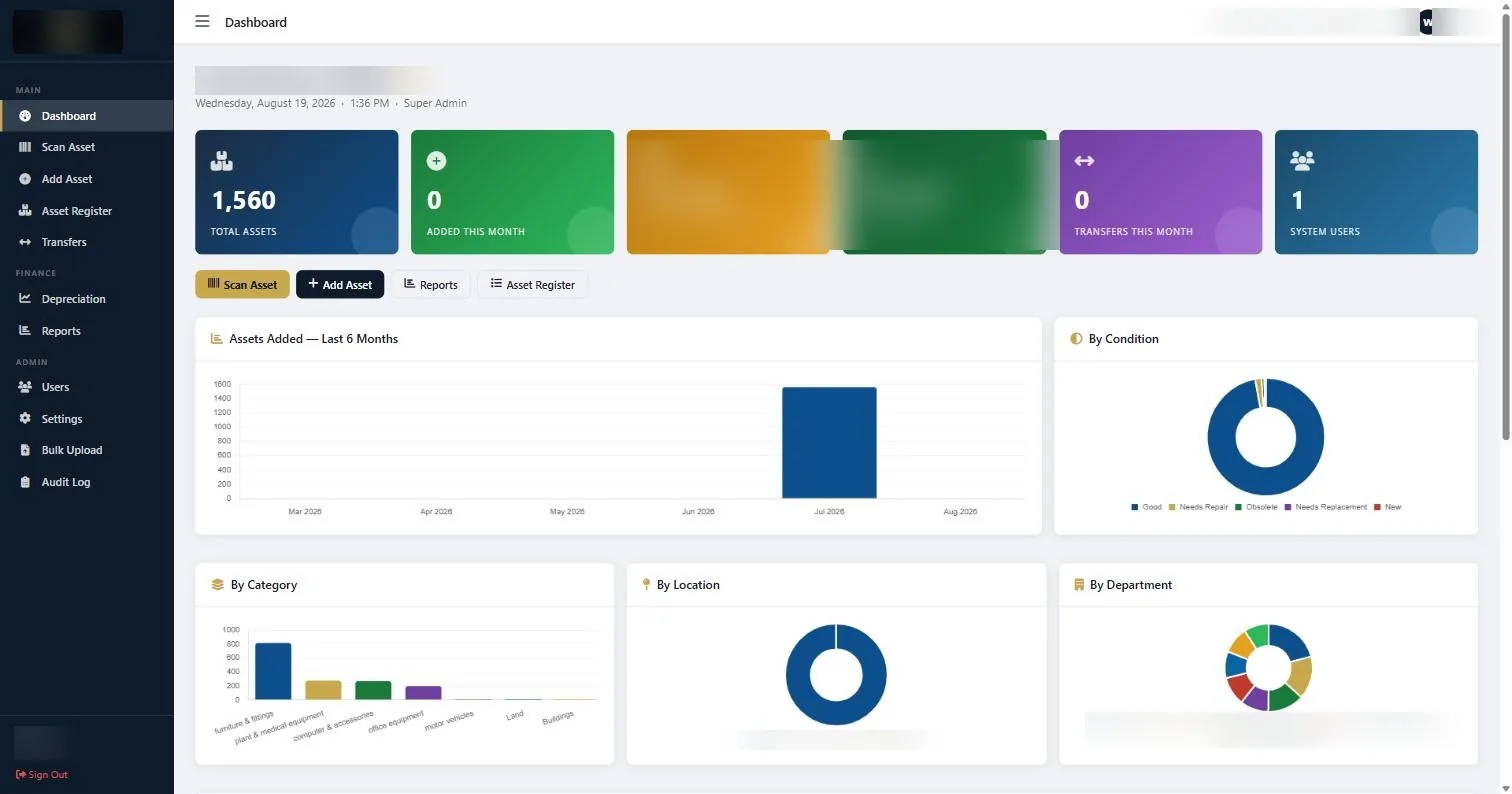
See how a structured register handles custodians, transfers, audits, maintenance, disposal and reporting in one place. Book an asset system demo →
Where tagging fits
Asset tagging is the mechanism that connects the record to the object. Without it, verification means matching descriptions to objects by eye, which is slow, inconsistent and unprovable.
A tag carries a unique asset number, printed on a material chosen for the surface and environment. Everything that can change lives in the register, not on the tag.
This is why the sequence is always the same on a real project: verify what physically exists, tag it, record it, then run the register. Our asset tagging service covers the first three and the asset management system the last.
The one-line version
Fixed asset management is the discipline of keeping a list true. Tagging is what makes the list checkable. Software is what makes keeping it true cheap enough to actually happen.
What good looks like
You can test your own position against these:
- Any asset can be located and identified in under a minute, by anyone with access.
- Every asset on the register has been physically confirmed within the last year.
- Transfers between people, departments and locations are logged with dates.
- Depreciation is calculated per asset by category, not estimated in bulk.
- Disposals are recorded, with the asset removed from the register and evidence kept.
- Your insurance declaration comes from the register, not from an estimate.
- Your auditors have not raised a fixed asset point in the last two cycles.
Most organisations meet two or three of these. That is normal, and it is also a reasonable definition of the gap worth closing.
How organisations actually get there
The projects that work follow a consistent shape:
- Verify. Walk the estate and confirm what exists. Expect the true count to run well above the register, typically by 20 to 40 percent.
- Reconcile. Remove what is gone, add what was never recorded, correct what is wrong. This is where the time and cost concentrate.
- Number and tag. A scheme that encodes site and asset class, on a tag material specified per environment.
- Load. The verified register goes into a system, not the old one.
- Maintain. Transfers logged as they happen, short verification walks on a cycle rather than one large annual count.
That was the shape of the Kenya Dairy Board project, where an existing register across 20-plus branches was verified and cleaned before more than 5,000 assets were tagged, and of Thika Water and Sewerage Company, over 2,000 assets across seven branches.
Common questions about what is fixed asset management
What is the difference between fixed asset management and inventory management?
Fixed assets have individual identity and are used over multiple years, so each one is tracked separately. Inventory is tracked by quantity and consumed or sold. You care which laptop is missing; you only care how many boxes of paper are left.
What should a fixed asset register contain?
At minimum: a unique asset number, description, serial number, category, acquisition date, cost, location, department, custodian and condition. Anything you would need to answer an auditor, an insurer or a replacement decision.
How often should a fixed asset register be verified?
Annually as a minimum, which is what most audit frameworks expect. In practice, short verification walks by department every quarter work better than one large annual count, because they catch drift while it is still small.
Do small organisations need fixed asset management?
The discipline, yes. The tooling, not necessarily. Under about 100 assets in one location with one person maintaining records, a spreadsheet plus tags is adequate. It stops being adequate at multiple sites, multiple editors, or when someone external asks you to prove the register.
What is a ghost asset?
An asset that appears on the register but no longer physically exists, usually because it was disposed of, lost or replaced without being written off. Ghost assets inflate your balance sheet, attract depreciation charges on nothing, and are one of the two standard audit findings in this area.
Where does depreciation fit into fixed asset management?
Depreciation is calculated from the register, so its accuracy depends entirely on the register’s accuracy. Depreciating ghost assets overstates cost and understates profit, while unrecorded assets are never depreciated at all. Fixing the register is a prerequisite, not a follow-on.
Anybody asking what is fixed asset management is usually really asking who is accountable. The register answers that question, and it is the reason the discipline exists at all.
Continue with the right next guide
Turn the process into a controlled workflow
See how a structured register handles custodians, transfers, audits, maintenance, disposal and reporting in one place.