
Asset tagging for manufacturing and industry
Asset tagging for manufacturing lives or dies on tag specification, because heat, oil and vibration destroy anything ordinary within a shift or two. Production lines, workshop tooling, spares stores and vehicle fleets. Anodised aluminium where heat and solvents would strip anything else, and a register that finally reconciles with the maintenance system.
Why this sector is different
Manufacturing has the harshest tagging environment of any sector we work in, and the most expensive consequences when a tag fails.
Heat, vibration, oil, coolant, solvent washdown and abrasive handling are ordinary conditions on a production floor. A printed label on a machine housing has a short life, and once it goes the asset is effectively anonymous. That matters more here than elsewhere because the assets are individually valuable and because they are already tracked, badly, in a second system.
That second system is the maintenance record. Almost every manufacturer runs one, and almost none of them reconcile to the fixed asset register. The same compressor carries a plant number in maintenance and a different line in the ledger, and nobody owns the mapping between them. When a machine is replaced, one system is updated and the other is not.
The third issue is the boundary between fixed assets, spares and consumables. A spare motor held in stores is inventory until it is fitted, at which point it may become part of a fixed asset. Get that boundary wrong and you either capitalise your stores or expense your plant.
What usually goes wrong
- Printed labels stripped from machinery by heat, oil and solvent washdown within months.
- Maintenance plant numbers and fixed asset register lines that have never been reconciled to each other.
- Workshop tools and test equipment below the capitalisation threshold, untracked, and repeatedly replaced.
- Machines replaced or rebuilt with the original asset still on the books and depreciating.
- Spares and consumables mixed into the fixed asset register, distorting both records.
What we tag in this sector
| Asset class | Why it matters here | Commonly missed? |
|---|---|---|
| Production machinery and lines | The core of the register by value, and the hardest tagging environment on site | No |
| Compressors, generators and utilities plant | High value, heat and vibration, usually tracked only by maintenance | Often |
| Workshop tooling and test equipment | Portable, below threshold, and the category most repeatedly replaced when untracked | Almost always |
| Forklifts and materials handling | Regulated and insured, so usually well recorded | No |
| Vehicles and trailers | Weather, washing and impact; individually recorded but rarely scannable | No |
| Laboratory and QC equipment | Calibrated on a technical schedule that rarely reconciles to the asset register | Often |
| Racking, conveyors and fitted plant | Capitalised into works contracts and never tracked as identifiable assets | Almost always |
| Office, IT and admin equipment | The usual reassignment problem in a comparatively easy environment | Often |
From first call to finished register
- Establish the fixed asset boundary firstWe agree what is a fixed asset, what is a spare, what is a consumable and how fitted spares are treated. Settling this at the start prevents a register that capitalises the stores.
- Reconcile with the maintenance systemPlant numbers are mapped to asset numbers so both systems point at the same machine. This is usually the highest-value part of a manufacturing project and it is rarely done anywhere else.
- Walk the floor and specify by zoneProduction, utilities, stores, workshop, laboratory and offices are six environments. Each gets its own tag specification rather than one type across the site.
- Verify and clean the registerMachines replaced or rebuilt but never written off are common. So is plant capitalised inside a works contract with no identifiable asset behind it.
- Tag around productionApplied in place, line by line, scheduled around shutdowns or shift patterns. We do not require production to stop.
- Deliver a register that reports properlyExportable by zone, cost centre, condition and category, with depreciation calculated per asset rather than estimated in bulk.
Work we have done
Our industrial work includes utility and plant environments where tag specification per zone is the determining factor. Thika Water and Sewerage Company is the closest published example: over 2,000 assets across seven branches in 2025, with tag material specified per environment because treatment works, plant rooms and offices are not the same setting.
For scale and multi-site consistency, Kenya Dairy Board shows the verification-first approach across more than twenty branches and over 5,000 assets.
We have supplied anodised aluminium tags into industrial settings across Kenya, and we are happy to discuss comparable work directly.
Common questions about asset tagging for manufacturing
Will asset tags survive on production machinery?
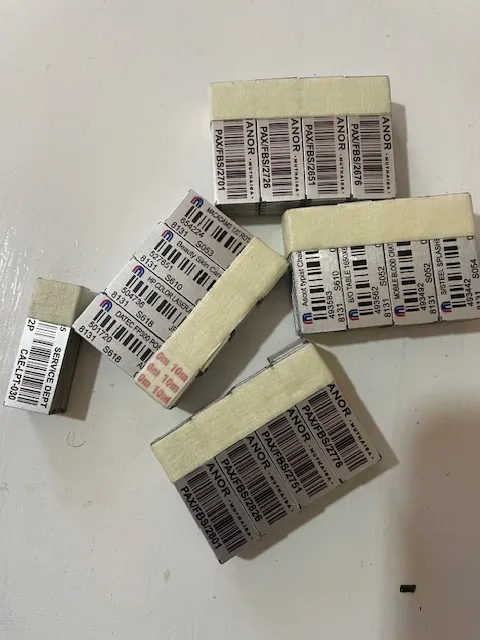
Anodised aluminium tags will. The image is anodised into the oxide layer of the metal rather than printed on top, so there is no ink film to abrade and no adhesive bond to fail under heat, vibration or solvent washdown. On plant they typically outlast the machine.
Can you reconcile our maintenance system with the fixed asset register?
Yes, and on manufacturing projects it is usually the most valuable part of the work. Plant numbers are mapped to asset numbers so both systems identify the same machine, and the mapping is documented rather than living in one person’s head.
Should we tag tools that are below our capitalisation threshold?
Usually yes. Capitalisation is an accounting decision about cost recognition; tagging is a control decision about whether you can locate an item. Tools that keep getting replaced are strong candidates, flagged as non-capitalised in the register.
How do we treat spares held in stores?
Spares held for use are inventory, tracked by quantity, not fixed assets. Once fitted they may form part of a fixed asset. Agreeing that boundary before the exercise starts is what stops the register and the stores record from contaminating each other.
Do you need to stop production?
No. Tagging is done in place, line by line, scheduled around shift patterns or planned shutdowns. Where a machine must be isolated for access, that is arranged with your team in advance.
What about machines that were rebuilt rather than replaced?
They need a decision: is the rebuild a repair, or has a new asset been created? Either answer is defensible, but the register has to reflect one of them. Rebuilt machines carrying the original asset and the original depreciation are a common finding.
Can the register feed our depreciation?
Yes. Our asset management system calculates depreciation per asset by category and acquisition date, with schedules and quarterly summaries exportable as CSV or PDF.
If you are scoping asset tagging for manufacturing across a plant or several sites, send us the asset count and we will come back with a fixed price and a mobilisation date.
Related guides
Ready to get your assets under control?
Call us to discuss your organisation, or email your asset list and we’ll scope it for you.