
Which assets in your business actually need tags?
Deciding which assets need tags is a filtering exercise, and the organisations that get it wrong tag either far too much or only the obvious. One rule decides most of it. The rest is knowing which categories organisations reliably miss, and why the capitalisation threshold is the wrong place to draw the line.
In this article
Which assets need tags: the short version
- Tag anything you would replace out of budget, or that someone could ask you to prove exists.
- Consumables and spare parts are inventory, not fixed assets. They do not get tags.
- The categories most often missed: furniture, soft furnishings, kitchen equipment, tools and fitted plant.
- The capitalisation threshold is an accounting line, not a tagging line. They overlap but are not the same list.
- Group assets by environment rather than department, because environment decides tag material.
The rule that decides it
Tag anything you would have to replace out of budget if it disappeared, and anything an auditor, insurer or funder could reasonably ask you to produce.
That is the whole rule. Everything below is applying it.
What it rules out is worth noting too. Consumables are not fixed assets. Stationery, cleaning supplies and spare parts held for use are inventory, not assets, and tagging them individually is effort spent on the wrong thing. If it gets used up, it does not get a tag.
The categories most organisations get right
IT equipment
Laptops, desktops, monitors, servers, network hardware, printers, projectors. High value, highly portable, and the category most likely to walk. Almost everyone tags these, and they are usually the first thing on the list.
Vehicles
Cars, vans, trucks, motorcycles, forklifts and trailers. Rarely missed, because they carry a registration and someone is already tracking them.
Plant and machinery
Generators, pumps, compressors, workshop equipment, production machinery. Usually tagged because the value is obvious, though often with the wrong tag material for the environment.
The categories most organisations miss
Furniture and fittings
Desks, chairs, cabinets, shelving, partitions. Individually low value, collectively substantial. A 200-person office holds more value in furniture than most finance teams assume, and almost none of it is on the register with a unique identifier.
Soft furnishings
Mattresses, carpets, curtains, upholstered seating, linen. This is the biggest blind spot we see, and it is not a small one. A hotel or a hospital can hold a meaningful share of its asset value in items that no rigid tag will attach to, so they get left off, and then they move between rooms, go out of service and get replaced piecemeal with nothing reconciling any of it.
They are tagged with polyester tags built for textiles. On the Pax Manor project this was exactly the category that needed its own specification alongside the 3,000-plus fixed assets and the 10,000-item inventory count.
Kitchen and catering equipment
Commercial fridges, ovens, cold rooms, dishwashers, prep equipment. High value, hard environment, and frequently recorded as one line item covering an entire kitchen.
Medical and laboratory equipment
Often on a maintenance schedule but not on the fixed asset register, or on both with different identifiers, which is worse.
Tools and portable equipment
Power tools, test equipment, survey instruments, cameras. Below the capitalisation threshold individually, easy to lose, and expensive to keep replacing.
Building fixtures and improvements
Air conditioning units, generators, water systems, security equipment, fitted kitchens. Capitalised as part of a building and then never tracked as identifiable assets.
Tag or do not tag: a working table
| Item | Tag it? | Why |
|---|---|---|
| Laptops, desktops, monitors | Yes | Portable, high value, frequently reassigned |
| Desks, chairs, cabinets | Yes | Low unit value, high aggregate value |
| Mattresses, carpets, curtains | Yes | Real value, moves constantly, almost never tracked |
| Generators, pumps, machinery | Yes | High value, long life, needs maintenance history |
| Vehicles and trailers | Yes | High value, regulated, insured individually |
| Power tools and test equipment | Yes | Portable and repeatedly replaced when untracked |
| Air conditioning and fitted plant | Yes | Capitalised but rarely identifiable on the register |
| Stationery and cleaning supplies | No | Consumable, not a fixed asset |
| Spare parts held for use | No | Inventory, tracked by quantity not identity |
| Leased equipment you do not own | Sometimes | Not your asset, but often worth tracking for control. Mark it clearly as leased |
Plan your asset tagging project
Send us your approximate asset count and locations and we will recommend the right tag, register structure and rollout plan. Request an asset tagging quote →
What about the capitalisation threshold?
Finance teams often assume the tagging list should match the capitalisation policy: if it was expensed rather than capitalised, it does not get a tag.
That is a reasonable default and a poor rule in practice. A KSh 15,000 power drill may sit below your threshold and still be the item most likely to disappear and most annoying to replace repeatedly. Capitalisation is an accounting decision about how cost is recognised. Tagging is a control decision about whether you can find something and prove it exists.
They overlap. They are not the same list. Where they differ, tag the item and flag it as non-capitalised in the register so the accounting stays clean.
How to build the list without a two-week project
- Start with the general ledger. Every capitalised asset for the last five to seven years. This is your floor, not your list.
- Walk one representative area. One floor, one branch, one department. Write down everything that fits the rule at the top of this article. You will find items that are not in the ledger, and the ratio tells you how far off the ledger is overall.
- Add the categories you know get missed. Furniture, soft furnishings, kitchen equipment, tools, fitted plant.
- Group by environment, not by department. This is what determines tag material. An office, a workshop, a kitchen and a plant room need different specifications regardless of who owns the budget.
- Decide the numbering before printing anything. A scheme that encodes site and asset class, like THW/ELEC/BR/3013, stays readable to a human and unique to the system. Do not encode anything that changes, such as department or custodian. That belongs in the register.
The verification step nobody wants to hear about
The list you build from records is not the list of assets you have. It never is.
On every project of any size we find two categories of error: assets on the register that no longer physically exist, and assets in daily use that were never recorded. Both distort the numbers, in opposite directions, which is why the net figure can look reasonable while every individual line is wrong.
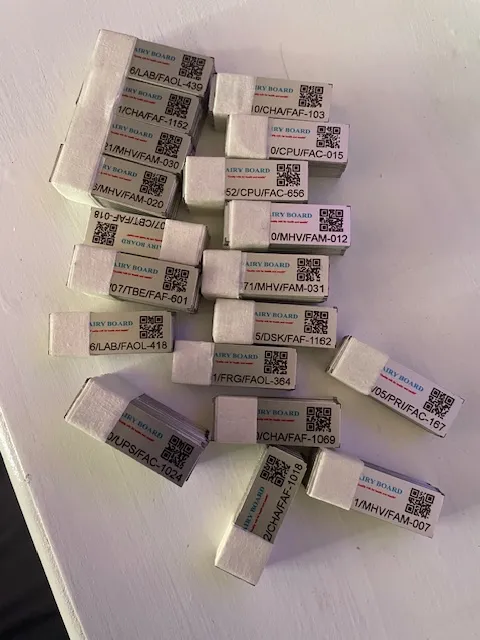
This is why we verify before tagging rather than after. On the Kenya Dairy Board project the register existed and looked complete; the work was confirming it against reality across 20-plus branches, cleaning it, and only then printing more than 5,000 tags against something true.
The order that matters
Verify, then tag, then record. Tagging against an unverified register just makes the wrong numbers scannable.
Common questions about which assets need tags
Should I tag assets below my capitalisation threshold?
Often yes. Capitalisation is an accounting decision about cost recognition. Tagging is a control decision about whether you can locate an item and prove it exists. A tool below the threshold that keeps getting replaced is a strong candidate for tagging, flagged as non-capitalised in the register.
Do I need to tag furniture?
Yes, in most organisations. Individually a desk is low value; across a large office the furniture holds substantial aggregate value and is almost never individually identifiable on the register. It is one of the most commonly skipped categories.
Can mattresses and carpets be tagged?
Yes, with polyester tags designed for textiles. Rigid metal and standard adhesive labels will not stay attached to fabric. This is the standard specification for hotels, hospitals and hostels.
Should leased equipment be tagged?
It is not your asset, so it does not belong in your fixed asset register in the same way. It is often still worth tagging for operational control, clearly marked as leased so nobody confuses it with owned equipment at audit.
What about consumables and spare parts?
Those are inventory rather than fixed assets. They are tracked by quantity, not by individual identity, so tagging each one is effort spent in the wrong place. Inventory management is a separate exercise and we handle it separately.
How many assets do most organisations find they were missing?
In our experience the true count typically runs 20 to 40 percent above what the existing register shows, driven mostly by furniture, small equipment and anything acquired outside the standard procurement route.
Settle which assets need tags before anybody prints anything. Adding a class later is straightforward. Removing thousands of tags you should never have applied is not.
Continue with the right next guide
Plan your asset tagging project
Send us your approximate asset count and locations and we will recommend the right tag, register structure and rollout plan.