Asset tagging services across Africa.
Asset tagging in Africa is a specification problem before it is a logistics problem, because heat, humidity and dust decide the tag long before the schedule does. Based in Nairobi, we tag and register fixed assets for organisations across East, Central and Southern Africa: durable barcode or QR tags, on-site verification, and a complete, audit-ready register.
What is fixed asset tagging?
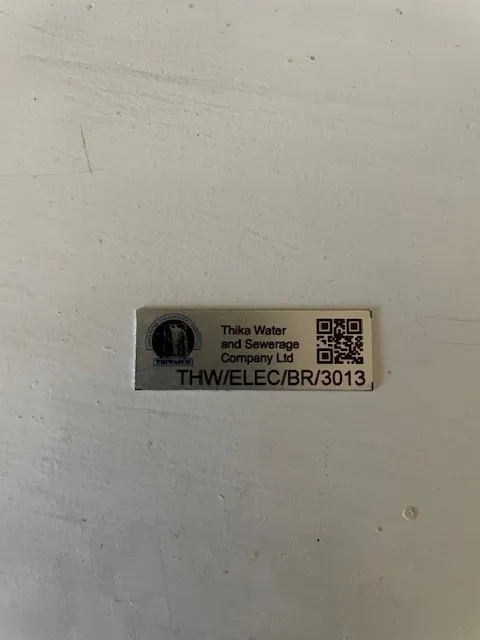
Asset tagging is the process of attaching a unique barcode or QR code label to each of a business’s fixed assets (IT equipment, furniture, machinery, vehicles and more) so every item can be identified, tracked and accounted for at a glance. Each tag links back to a central asset register that records the item’s location, condition, custodian and value.
The need is the same everywhere we’ve worked: businesses accumulate assets faster than they track them, and a spreadsheet someone updates occasionally is not a defensible record for an auditor, an insurer, or a finance team trying to close the books. For a deeper walkthrough of the definitions, process and common mistakes, see our full guide on what asset tagging actually is.
Asset tagging in Africa: regions we serve
Our home base and deepest project history is Kenya, where we’ve delivered tagging projects for organisations including Carrefour Kenya, Kenya Dairy Board and Thika Water and Sewerage Company. We also take on projects further afield across East, Central and Southern Africa. If your country isn’t listed below with its own page yet, that doesn’t mean we can’t help: get in touch and we’ll scope it.
East Africa
- Kenya (our home market: see our dedicated Kenya tagging page)
- Uganda
- Tanzania
- Rwanda
- Ethiopia
- Other East African markets on request
Central Africa
- DR Congo
- Republic of Congo
- Cameroon
- Gabon
- Other Central African markets on request
Southern Africa
- South Africa
- Zambia
- Zimbabwe
- Botswana
- Namibia
- Other Southern African markets on request
Individual country pages are being added as projects are confirmed in each market, so this list will grow. This page stays the fastest way to reach us if you don’t see your country listed yet.
Fixed asset tagging services, wherever you operate
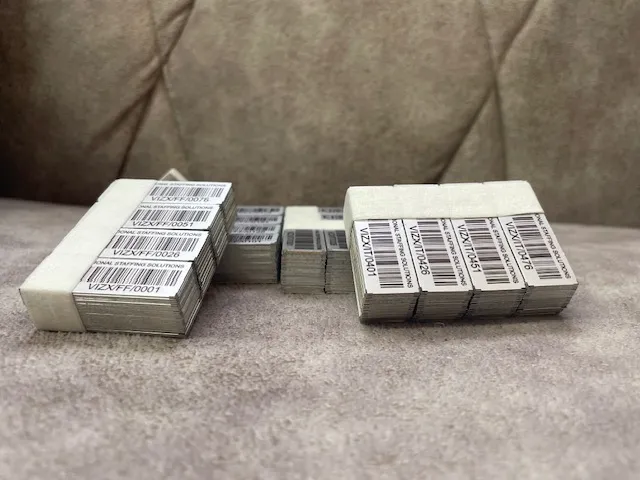
Barcode asset tags
Durable 1D barcode labels for fast, reliable scanning with standard barcode readers, ideal for high-volume asset registers.
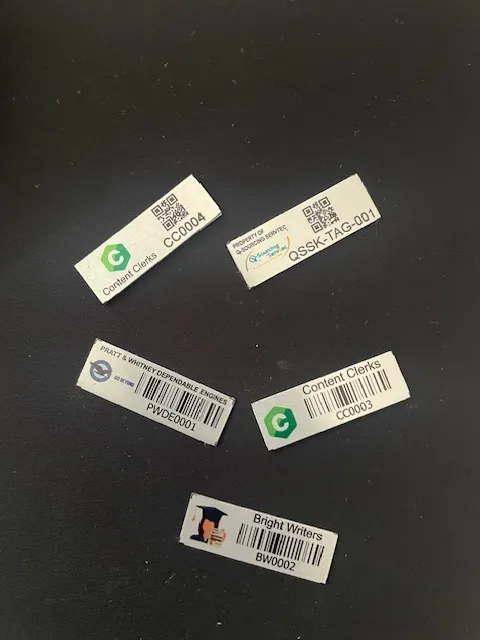
QR code asset tags
QR tags store more data and scan with any smartphone camera: no dedicated scanner required for quick field checks.
Anodized aluminium tags
Rigid aluminium tags built to survive outdoor conditions, heat and heavy handling: the standard for machinery and vehicles.
We also supply anodised aluminium tags for outdoor and industrial plant, self-adhesive tags for everyday office equipment, acetone-activated tags where removal resistance matters, and polyester tags for soft furnishings such as mattresses and carpets. Tag type is specified per surface rather than applied uniformly across an estate.

Asset tagging pricing across Africa
The published KSh tagging tiers below apply across our service area. Final cross-border quotations list travel and mobilisation separately, based on country, number of sites and delivery requirements.
| Volume | Price per tag (KES) | What is included |
|---|---|---|
| 20 to 100 tags | From KSh 150 | Design, numbering and printing |
| 101 to 1,000 tags | From KSh 100 | Plus on-site tagging and data capture |
| Above 1,000 tags | From KSh 80 | Plus full asset register, soft and hard copy |
| Asset management software | KSh 120,000 one-time | All features, unlimited users, setup and training |
Published KSh tagging tiers apply across our service area. Anodised aluminium and acetone-activated tags carry a premium over self-adhesive polyester and vinyl; cross-border travel and mobilisation are quoted separately. See our pricing page.
What drives the quote
| Factor | Effect on price |
|---|---|
| Order volume | Design and setup are fixed, so per-tag cost falls sharply with quantity |
| Tag type | Anodised aluminium and acetone-activated cost more than self-adhesive polyester |
| On-site data capture | Supplying tags is one cost; verifying and capturing every asset on site is another |
| Number of sites and country | Travel, logistics and in-country time vary considerably across the region |
Why businesses need fixed asset tagging
Untagged assets are assets you can’t prove you own. Three reasons this keeps coming up with the organisations we work with, in Kenya and beyond:
Audits and compliance
Statutory and internal auditors increasingly expect a verifiable register, not a spreadsheet someone updates when they remember to. Most tax and audit frameworks across the region penalise depreciation claims that aren’t backed by defensible records.
Insurance and loss prevention
A tagged, photographed, serial-numbered asset is a claim you can actually win. An untagged one is a dispute, and disputes take months to resolve.
Operational efficiency
Manual stock-takes on an untagged estate can take days and still miss things. Scanning a tag takes seconds and can’t misread a description the way a person can.
This isn’t a uniquely Kenyan or East African concern; it’s formalised internationally in standards like ISO 55000 for asset management. It matters more in markets where relatively few local businesses have adopted it yet, which means the ones that have are noticeably harder to catch out during an audit.
From first call to finished register
The workflow is the same regardless of country. Here’s what actually happens at each stage.
Scoping and verification
You tell us roughly how many assets you have and where they’re located, and we give you an estimate based on volume, material and country. Every asset is then checked against existing records, or counted fresh if there isn’t one, before a single tag is printed.
Tagging and register delivery
The physical tag goes on, and its make, model, serial number, condition, location and custodian are recorded against the tag’s unique code. You receive a complete, exportable asset register, ready for finance or for our asset management software.
Which assets require tagging?
As a rule of thumb, if an item is worth tracking on a balance sheet, has a useful life longer than a year, and could plausibly go missing or be misallocated, it belongs on the list. In practice that usually covers:
IT Equipment
Furniture
Vehicles
Medical Equipment
Machinery & Tools
Electronics
Built for organisations with assets to protect
Common questions about asset tagging in Africa
Do you only work in Kenya?+
My country isn’t listed. Can you still help?+
Does pricing differ by country?+
Can you also supply the asset management software outside Kenya?+
What tag types do you supply?+
What is the difference between a barcode and a QR code tag?+
Asset tagging country by country
Every market has its own conditions, reporting framework and logistics. These pages cover what changes when the work crosses a border.
When you plan asset tagging in Africa across more than one country, agree the numbering convention centrally and let each site apply it. Consolidating six registers that each numbered assets their own way is the most expensive avoidable task in this work.
Wherever you’re based, let’s talk about your assets
Tell us your country and roughly how many assets you have, and we’ll scope the project and give you an estimate.