
How much does asset tagging cost, and what actually drives the number?
Asset tagging cost is quoted per asset almost everywhere, which hides the fact that four separate things are being priced at once. Rates start at KSh 80 per tag. What decides your total is asset count, site count, the state of your current register and what the assets are made of. Here is how to estimate before you ask for a quote.
In this article
Asset tagging cost: the short version
- Tagging starts at KSh 80 per tag; the software is KSh 120,000 one-time with no subscription.
- The biggest cost driver is not tags, it is verifying what you actually have.
- Most organisations underestimate their true asset count by 20 to 40 percent.
- Multiple sites cost more than the same asset count in one building.
- Tag material matters: plant and soft furnishings cost more per asset than office equipment.
The short answer, and why it is not the whole answer
Asset tagging in Kenya starts at KSh 80 per tag, and our fixed asset management system is KSh 120,000 as a one-time licence with no monthly fee. Those numbers are published on our pricing page and they are real, not a starting point for negotiation.
But per-tag pricing answers a narrower question than most people are asking. What organisations usually want to know is what the whole exercise will cost, and that depends on things a rate card cannot see: how many assets you actually have, how accurate your current records are, how many sites we need to visit, and what materials the assets require.
This article is about those variables, so you can estimate a realistic budget before anyone quotes you.
What the per-tag rate covers
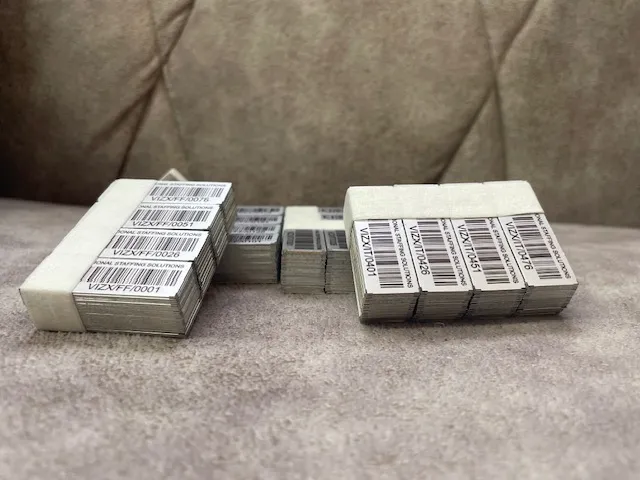
The tag rate is not just a piece of printed material. On our projects it covers the tag itself, printed with your organisation name and a unique asset number, plus the on-site work to apply it and record it against the register.
What it does not cover, and what tends to surprise people, is the state of the data before tagging starts. If your register is accurate, tagging is a mechanical exercise. If it is not, and it usually is not, someone has to reconcile it first.
The single biggest cost driver
It is not the tags. It is verification: physically confirming what exists, finding what was never recorded, and removing what was disposed of years ago but never written off. On most projects this is where the days go.
The variables that move the number
1. Asset count
The obvious one, and the one people are least accurate about. Organisations routinely underestimate by 20 to 40 percent, because registers omit low-value items, assets bought outside the normal procurement route, and anything acquired in the last eighteen months. Unit rates come down with volume, so a higher true count is not proportionally worse.
2. Number of sites
Two thousand assets in one building and two thousand assets across seven branches are different projects. The tagging is identical; the travel, mobilisation and coordination are not. When we tagged over 2,000 assets for Thika Water and Sewerage Company across seven branches, the branch count shaped the schedule more than the asset count did.
3. Condition of the existing register
There are three starting points, and they cost differently:
- No register at all. Cleaner than it sounds. Everything is captured fresh and there is nothing to reconcile.
- A register that is broadly right. The cheapest scenario. Verify, correct the gaps, tag.
- A register that has drifted. The most expensive. Every line has to be tested against reality, ghost assets removed, unrecorded assets added. This is what we did across 20-plus branches for Kenya Dairy Board before a single tag was printed.
4. Tag material
Self-adhesive is the cheapest per unit. Anodised aluminium costs more. Polyester tags for soft furnishings and acetone-activated tags sit in between and take longer to apply. An estate that is mostly office equipment costs less per asset than one that is mostly plant, vehicles and machinery. The asset tags page covers what each type is for.
5. Whether you also want the software
Tagging gives you a register. Software gives you something that stays current: transfers logged, depreciation calculated, reports exported. Our asset management system is a one-time KSh 120,000 licence rather than a subscription, which changes how it compares to cloud tools over three or four years.
Working out a realistic budget
A rough method that gets most organisations close enough to plan:
- Take your current asset count and add 30 percent. If you have no register, count one representative floor or department and extrapolate.
- Split it by tag type. Roughly what proportion is office and IT equipment, what proportion is plant, vehicles or outdoor, and what proportion is soft furnishings.
- Multiply by the per-tag rate. Start from KSh 80 and expect the plant and soft-furnishing portions to sit above that.
- Add for sites. Anything beyond a single location adds mobilisation.
- Decide on software separately. It is a one-time cost, not a per-asset one.
That gives you a planning figure. A real quote needs a conversation about the estate, but you should not need one to know whether this fits in your budget at all.
Turn your approximate asset count into a firm quote
Send the approximate number of assets, branches and preferred tag material. We will return a clear scope and quotation. Get a firm quote →
What it is worth comparing against
The question is rarely whether tagging is expensive in isolation. It is what the alternative costs.
| Situation | What it typically costs |
|---|---|
| Assets on the books that no longer exist | Depreciation charged on nothing, and an audit finding when someone checks |
| Assets in use that were never recorded | Understated asset value, and no claim if they are lost or stolen |
| An annual count done manually | Days of staff time, repeated every year, with results nobody fully trusts |
| Insurance based on an unverified register | Premiums on the wrong number, and a difficult conversation at claim time |
| Audit queries on fixed assets | Finance team time spent reconstructing records that should already exist |
For most organisations of any size, one properly executed tagging exercise costs less than two years of doing the count by hand and still not being confident in the answer.
Pricing outside Kenya
We work across East, Central and Southern Africa. The same published KSh tag tiers apply outside Kenya and are set out on the asset tagging in Africa page; cross-border travel and mobilisation are quoted separately.
What we need from you to quote accurately
Three things get you a firm number quickly:
- Your current register, in whatever state it is in. A messy spreadsheet is more useful than nothing, and we are not going to judge it.
- A list of sites and a rough asset count at each.
- A sense of the asset mix. Mostly office? Mostly plant? Hotel with a lot of soft furnishings?
Email that to sales@stlassetsolutions.com and we will scope it. If you would rather talk it through first, the number is on the pricing page.
Common questions about asset tagging cost
How much does asset tagging cost per asset in Kenya?
From KSh 80 per tag, covering the printed tag, on-site application and recording against the register. Rates come down with volume and vary with tag material, since anodised aluminium and polyester tags cost more than standard self-adhesive labels.
Is there a minimum project size?
No. We work with organisations tagging a few dozen assets in one office and with estates running into thousands across many branches. The process is the same; only the scale and the schedule change.
How much does the asset management software cost?
KSh 120,000 as a one-time licence, with unlimited staff accounts and no monthly fee. It includes the full asset register, barcode scanning, transfers, depreciation schedules and twelve built-in report types.
Do you charge extra for multiple branches?
Multiple sites add mobilisation and travel to the total, so a project spread across seven branches costs more than the same asset count in one building. It is quoted transparently rather than hidden in the per-tag rate.
What if my existing asset register is a mess?
That is the normal starting point and it is part of the job. We verify what physically exists, remove what was disposed of but never written off, and add what was never recorded. The output is a register you can rely on rather than a tidier version of the same guesswork.
Are there ongoing fees after the project?
No. Tagging is a one-time exercise and the software licence is one-time. There is no subscription and no per-asset annual charge. If you want us to come back for a periodic verification, that is quoted separately when you ask for it.
When you compare quotes, put the asset tagging cost per asset next to the tag specification for that quote. A cheaper number against a thinner tag is not a cheaper project, it is a shorter one.
Continue with the right next guide
Turn your approximate asset count into a firm quote
Send the approximate number of assets, branches and preferred tag material. We will return a clear scope and quotation.